Shark HP102 Review: A Big-Brand Sensor in a Small-Room Body?
120 sq ft (4.8 ACH)
3-stage NanoSeal True HEPA + activated carbon
80 / 91 / 94 CFM (Smoke / Dust / Pollen)
36-52 dB (measured)
Methodology & sources
TestedThis review is backed by a validated long-term test record retained by Claire Fontaine.
Verified on August 8, 2026
Pros
- A tri-particle PM1/PM2.5/PM10 sensor that is rare in a unit this small
- Big-brand build with a long warranty behind it
- Very low power draw, near 20 watts even at full speed
- Purely mechanical filtration with no ionizer in the air path
Cons
- The 500 sq ft coverage claim is badly overstated for real allergy-grade cleaning
- The three-stage filter is replaced as a single combined part
- No Wi-Fi, app or remote scheduling, only the onboard controls
- On its top speed it is clearly audible for such a small unit
Best for
- A small bedroom, office or nursery up to roughly 120 to 200 sq ft
- Buyers who want a genuine PM1, PM2.5 and PM10 sensor in a compact body
- Anyone who wants a big-brand build with purely mechanical, ionizer-free filtration
Spec comparison
| Spec comparison | Shark HP102 Clean Sense IQ | BLUEAIR Blue Pure 211i Max | BLUEAIR Blue Pure 311i Max |
|---|---|---|---|
| CADR | 80 / 91 / 94 CFM (Smoke / Dust / Pollen, ENERGY STAR) | 435 / 453 / 450 CFM (Smoke / Dust / Pollen, AHAM Verifide) | 283 / 314 / 365 CFM (Smoke / Dust / Pollen, AHAM Verifide) |
| Coverage | 124 sq ft (ENERGY STAR); cleans up to 500 sq ft | 674 sq ft (4.8 ACH) | 439 sq ft (4.8 ACH) |
| Power | 24 W | 46 W | 32 W |
| Filter type | Anti-Allergen NanoSeal filter with true HEPA + Odor Lock carbon | HEPASilent dual filtration; Particle & Carbon main filter + washable fabric pre-filter | HEPASilent dual filtration; Particle & Carbon main filter + washable fabric pre-filter |
| Filter life | 6-12 months | 6-9 months (main filter); pre-filter washable | 6-9 months (main filter); pre-filter washable |
| Warranty | 2-year limited | 1 year limited; 3 years with product registration | 1 year limited; 3 years with product registration |
| Dimensions | 8.65 x 8.65 x 14.5 in (L x W x H) | 22.7 x 14.4 x 14.4 in (H x W x D) | 19 x 12.5 x 12.5 in (H x W x D) |
| Weight | 5.85 lbs | 16.2 lbs | 7.8 lbs |
| Noise level | — | 23-53 dB | 23-50 dB |
If you want a capable air-quality sensor and a big-brand name in a compact purifier for a small bedroom, office or nursery, the Shark HP102 Clean Sense IQ is worth a look — as long as you size it honestly. Its standout trait is a sensor that reads PM1, PM2.5 and PM10 separately and drives a real auto mode, a level of sensing usually reserved for pricier machines. It filters mechanically, with no ionizer in the air path, and it sips electricity. For a room of roughly 120 to 200 square feet, it is a tidy, sensible little unit.
Who should skip it? Anyone shopping for the 500 square feet printed on the box. That headline is a serious overstatement of what the HP102 can keep genuinely clean, and buyers with a real living room or open-plan space should step up to a larger purifier rather than trust the marketing. Treat the Shark as the small-room specialist it actually is and it makes sense; ask it to cover the space its packaging implies and it will disappoint.
The sensor is the headline
The reason to consider the HP102 over a plain compact purifier is Clean Sense IQ. Rather than the single good-or-bad light on most small units, the Shark carries a sensor that measures across three particle sizes — PM1, PM2.5 and PM10 — and reports them in real time while adjusting the fan on its own.
That three-way split matters more than it sounds. PM10 covers coarse particles like pollen and larger dust; PM2.5 is the fine particulate most associated with respiratory harm; and PM1 captures the ultrafine fraction from smoke and combustion that many cheaper sensors miss entirely. Finding all three in a unit this compact is genuinely unusual — it is the same class of sensing the Coway Airmega Mighty2 puts in a much larger machine. For anyone who wants to actually watch their air quality respond when someone cooks or lights a candle, this is the HP102's best argument.
CADR and the honest room-size math
Here is where the marketing needs translating. Shark rates the HP102 with Clean Air Delivery Rates of 80 CFM for smoke, 91 CFM for dust and 94 CFM for pollen. Those are the numbers that predict real performance, and they are modest — appropriate for a small unit, not the 500-square-foot machine the box advertises.
Apply the coverage rule this site uses for every purifier: multiply the smoke CADR by 1.5 to find the area the unit can clean at a meaningful 4.8 air changes per hour.
- 80 CFM x 1.5 = about 120 square feet at 4.8 air changes per hour.
That is the honest working size: a small bedroom, a home office, a nursery. The 500 square feet on the packaging is the same machine measured at a single air change per hour, a slow cadence for holding already-clean air rather than knocking down an active problem. The independent reviewers at HouseFresh put it bluntly, judging the 500-square-foot claim "too big a space, at least half this" and recommending the HP102 for rooms "no bigger than 200 sq. ft." Treat 500 square feet as a theoretical ceiling and roughly 120 to 200 square feet as the room where the Shark does its best work. (New to these numbers? The how to choose an air purifier guide walks through CADR, ACH and coverage.)
What "quiet enough" costs you in coverage
A CADR figure is measured at a unit's loud top speed, and clean-air delivery falls as the fan slows. On a small purifier that leaves little headroom: run the HP102 on its quiet lower speeds overnight and its already-modest airflow drops further, which is another reason to keep it in a genuinely small room where even a reduced clean-air rate still turns the air over often enough.
The clearing pace backs this up. HouseFresh recorded the HP102 taking about 38 minutes to clear its 728-cubic-foot chamber at full speed — on the slow side for the category, and exactly what you would expect from an 80 CFM smoke CADR. In a small bedroom that pace is fine, because the volume of air is small; point it at a large lounge and the same fan simply cannot keep up.
Filtration: NanoSeal HEPA and the True HEPA question
The HP102 runs a three-stage filter: a pre-filter for coarse debris, an activated-charcoal layer for light odors, and Shark's NanoSeal HEPA media as the main particle stage, treated with a Microban antimicrobial coating. Shark rates it to capture 99.98% of particles down to 0.1 to 0.2 microns, tested to the IEST standard rather than the classic 0.3-micron True HEPA benchmark. In practice that is a strong particle filter; the different reference size is worth understanding rather than fearing, and the HEPA vs True HEPA guide explains why the label wording varies between brands.
The trade-off is the combined design. When any single layer is spent, the whole assembly is replaced together, and Shark puts that cycle at roughly six to twelve months depending on load. For light odors — everyday cooking, general freshness — the carbon layer is adequate; for heavy, constant odor a purifier built around a deep granular carbon bed like the Winix 5510 will hold up far longer.
Running cost, kept qualitative
The HP102 is cheap to live with in the way that matters day to day: it barely touches the power bill. HouseFresh measured a maximum draw of only about 20 watts at full speed and effectively nothing on standby, which is remarkably frugal, and the auto mode keeps the fan low when the air is already clean. The one recurring expense to plan for is that combined three-stage filter on its six-to-twelve-month cycle; a household with pets or heavy cooking will replace it sooner, since the carbon and pre-filter load faster than the HEPA media wears out.
Noise and design
For such a small machine the HP102 is honest about its noise. HouseFresh measured 36.1 dBA on the lowest speed — quiet enough to ignore in a bedroom — rising to 52.2 dBA flat out, which is clearly audible and best reserved for a quick clean-down rather than overnight running. The sensible approach is to let auto mode sit on the lower speeds and only surge when the sensor sees a spike.
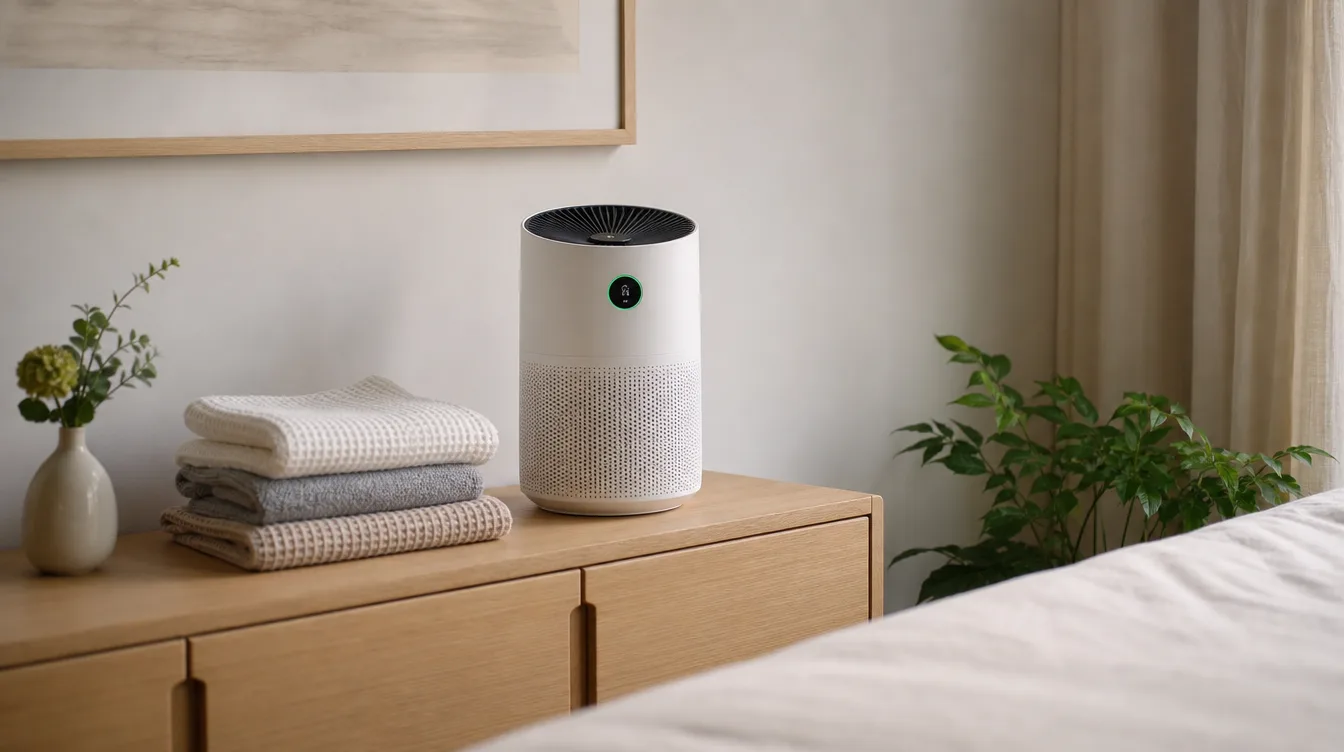
The design is the other small-room advantage. At under six pounds and a footprint smaller than a sheet of paper, the HP102 is genuinely compact and easy to move between rooms, with a clean, brand-forward look. What it does not have is connectivity: there is no Wi-Fi, no app and no remote scheduling. Clean Sense IQ runs entirely onboard, so everything happens through the physical controls and the sensor — simpler than an app-driven purifier, but no phone control for anyone who wants it.
The third-party consensus
Because this site does not run a lab, the honest way to judge a purifier is to aggregate the independent reviewers who do. On the HP102 the standout source is HouseFresh, whose bench provides the numbers throughout this review: the roughly 20-watt power draw, the 38-minute clean-down of its chamber, the 36-to-52 dBA noise range, and — most importantly — the verdict that the 500-square-foot coverage claim is at least double what the unit can realistically manage. The consistent thread is a competent, sensor-rich small-room purifier let down only by marketing that oversells its reach.
Who should buy it
Small-room buyers who value a good sensor are the target. In a bedroom, office or nursery of 120 to 200 square feet, the HP102's tri-particle Clean Sense IQ sensor and auto mode are genuinely useful, and few compact units sense this well.
Big-brand and simplicity shoppers get a recognizable name, a purely mechanical air path with no ionizer, and an appliance that runs entirely from its onboard controls without an app to set up.
Who should skip it
Anyone with a real living room or open plan should look elsewhere. The 80 CFM smoke CADR simply cannot clean the space the 500-square-foot claim implies; a larger unit such as the LEVOIT Core 400S or a step up into large-room territory is the right call.
Buyers who want app control will find the HP102 deliberately basic. A smart bedroom unit like the LEVOIT Core 300S adds Wi-Fi, scheduling and app-based air-quality history.
How it compares
Against the LEVOIT Core 300S, the two are natural small-room rivals: the Shark counters with a more capable PM1/PM2.5/PM10 sensor and a big-brand build, while the LEVOIT adds Wi-Fi, app scheduling and a slightly larger honest coverage. Against the LEVOIT Core Mini, the HP102 is the more serious machine — a real sensor and auto mode versus the Mini's plug-in-and-forget simplicity — at the cost of a larger body. And against the Coway Airmega Mighty2, the Coway offers the same class of laser sensing but backs it with far more airflow for a genuine 360-square-foot room, which is the unit to choose when the space is bigger than the Shark can honestly handle. For a fuller shortlist across every use case, see the best air purifiers guide.
Verdict
The Shark HP102 Clean Sense IQ is a compact, sensor-rich purifier that earns its place in a small room and oversells itself on the box. Its PM1/PM2.5/PM10 sensor and auto mode are unusually good for the size, it filters mechanically with no ionizer, and it draws barely 20 watts. The catch is coverage: its 80 CFM smoke CADR translates to an honest 120 square feet, not the advertised 500, and independent reviewers put the realistic ceiling nearer 200. Buy it for a small bedroom, office or nursery where its sensing shines, ignore the packaging math, and the HP102 is a likable little unit; buy it for the room its marketing implies, and a bigger purifier is the smarter spend.
Editorial summary
A full review of the Shark HP102 Clean Sense IQ, covering its NanoSeal HEPA filtration, PM1/PM2.5/PM10 Clean Sense IQ sensor, frugal power draw and the gap between its 500 sq ft claim and its honest small-room coverage.
Where to buy
Check the merchant for the current price and availability. We may earn a commission.