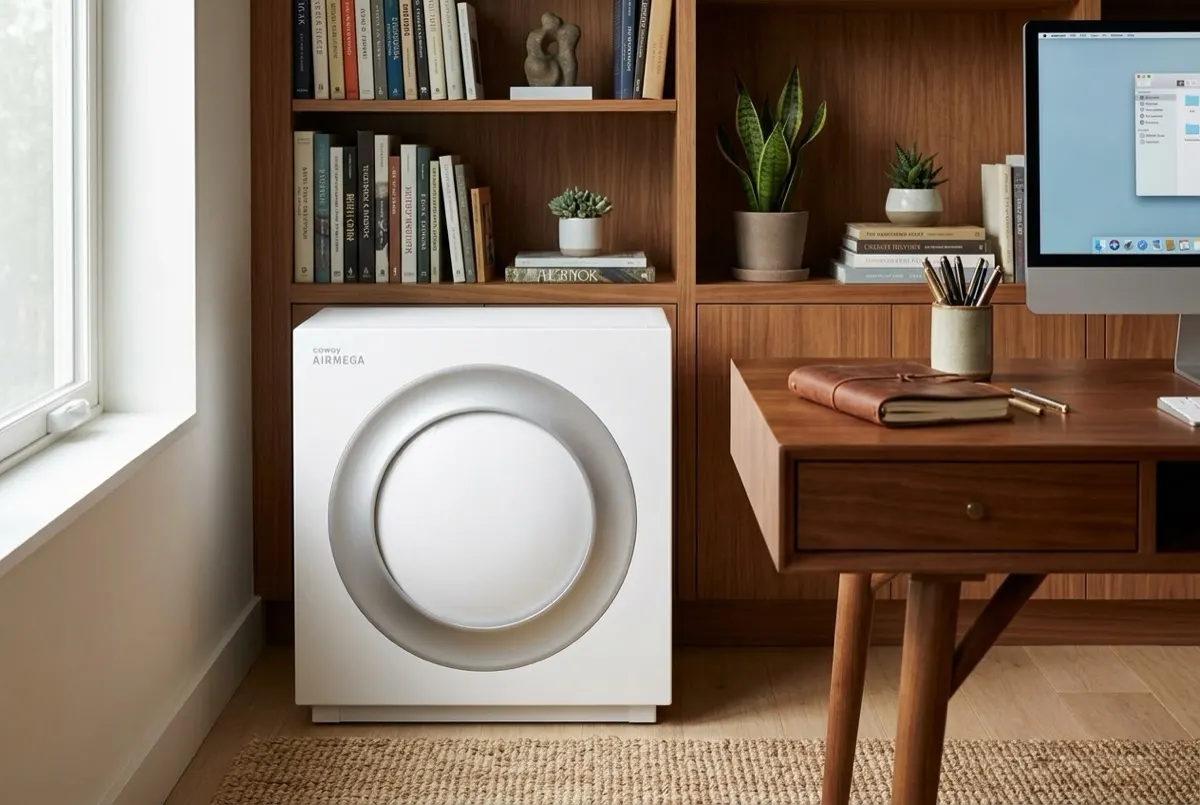
Coway Airmega Mighty2 Review: The AP-1512HH, Reengineered
360 sq ft (4.8 ACH)
Washable pre-filter + Max2 HEPA and Carbon
240 / 242 / 249 (Smoke / Dust / Pollen)
19-51 dB
Methodology & sources
TestedThis review is backed by a validated long-term test record retained by Claire Fontaine.
Verified on August 8, 2026
Pros
- True HEPA rated to 99.97% at 0.3 microns in a sealed Max2 panel
- MegaScan laser reads PM1, PM2.5 and PM10 separately
- Very quiet floor around 19 dB for bedrooms
- Drops the bipolar ionizer and cuts peak power use
Cons
- Single Max2 filter must be replaced as one part
- No cooling or humidification, purely a purifier
- Smart features rely on the Coway companion app
Best for
- Allergy sufferers in bedrooms and living rooms up to 360 sq ft
- Buyers who want the AP-1512HH platform without a bipolar ionizer
- Anyone who values simple single-filter swaps
Spec comparison
| Spec comparison | Coway Airmega Mighty2 | BLUEAIR Blue Pure 211i Max | BLUEAIR Blue Pure 311i Max |
|---|---|---|---|
| CADR | 240 / 242 / 249 CFM (Smoke / Dust / Pollen) | 435 / 453 / 450 CFM (Smoke / Dust / Pollen, AHAM Verifide) | 283 / 314 / 365 CFM (Smoke / Dust / Pollen, AHAM Verifide) |
| Coverage | 1,800 sq ft (1 ACH) | 674 sq ft (4.8 ACH) | 439 sq ft (4.8 ACH) |
| Noise level | 19-50 dB | 23-53 dB | 23-50 dB |
| Power | 56 W | 46 W | 32 W |
| Filter type | Washable pre-filter + Max2 filter (activated carbon + HEPA) | HEPASilent dual filtration; Particle & Carbon main filter + washable fabric pre-filter | HEPASilent dual filtration; Particle & Carbon main filter + washable fabric pre-filter |
| Filter life | Max2 filter 1 year; pre-filter washable | 6-9 months (main filter); pre-filter washable | 6-9 months (main filter); pre-filter washable |
| Warranty | 1 year (parts); 3 years (motor and electronic parts) | 1 year limited; 3 years with product registration | 1 year limited; 3 years with product registration |
| Dimensions | 16.9 x 17.9 x 9.3 in (W x H x D) | 22.7 x 14.4 x 14.4 in (H x W x D) | 19 x 12.5 x 12.5 in (H x W x D) |
| Weight | 15.2 lbs | 16.2 lbs | 7.8 lbs |
Few appliances earn the kind of loyalty the Coway AP-1512HH did. For the better part of a decade it was the purifier that reviewers pointed to when someone asked for the single safest recommendation — a quiet, reliable, sensibly priced True HEPA machine that simply worked, year after year, in bedroom after bedroom. Replacing a product that beloved is a delicate business. Change too little and there is no reason to upgrade; change too much and you break the very thing people trusted. The Airmega Mighty2 is Coway's attempt to thread that needle, and for the most part it succeeds by being smarter, quieter and cleaner without losing the plot.
Coway markets the Mighty2 plainly as the next generation of the AP-1512HH, the same platform that also sells under the Airmega 200M name reviewed elsewhere on this site. The bones are familiar. What Coway changed is targeted and, in a couple of cases, genuinely thoughtful — including one decision that quietly removes a feature some buyers actively disliked.
Same platform, reengineered
If you have lived with an AP-1512HH or an Airmega 200M, the Mighty2 will feel instantly recognizable. The compact rectangular body, the front intake, the top-mounted controls and the color-changing air quality ring are all carried forward. This is deliberate: Coway is not trying to reinvent a classic, only to modernize it.
The changes cluster around three areas. The filtration is consolidated into a single combined panel. The air quality sensing is upgraded from a basic particle detector to a laser array. And the electronics have been reworked to run quieter and draw less power at peak. One notable subtraction sits alongside those additions — the bipolar ionizer that the old model included has been dropped entirely. Taken together, these are the moves of a company refining a proven design rather than gambling on a new one.
The Max2 filter: one panel, two jobs
The biggest structural change is how the Mighty2 handles filtration. The AP-1512HH used a separate deodorization filter and a separate HEPA filter. The Mighty2 combines them into a single unit Coway calls the Max2 filter, which folds activated carbon and True HEPA media into one replaceable panel, sitting behind a washable pre-filter.
The washable pre-filter is unchanged in spirit: a mesh screen that catches hair and large dust and rinses clean in a sink, protecting the media behind it and costing nothing to maintain.
The Max2 panel is where particles and odors are handled together. Its True HEPA layer is rated to capture 99.97% of airborne particles down to 0.3 microns — the medically meaningful most-penetrating size that covers pollen, dust, dander, mold spores and fine smoke particulate. Its integrated carbon layer adsorbs everyday odors and light volatile organic compounds.
There is a genuine trade-off baked into this design. On the plus side, replacement is dead simple: one panel, one swap, no juggling of separate cartridges or trying to remember which filter is due. On the minus side, when either the carbon or the HEPA media is spent, the whole Max2 panel is replaced as a single part, so you cannot renew one layer independently of the other. For most households the convenience is worth it; for tinkerers who liked being able to swap the carbon and HEPA on different schedules, it is a small loss.
Dropping the ionizer: a feature by subtraction
One of the quieter but more welcome changes is what the Mighty2 leaves out. The old AP-1512HH included a bipolar ionizer, an optional stage that some owners liked and others switched off out of concern over trace ozone. Coway has removed it from the Mighty2 altogether.
This is worth calling out as a genuine improvement rather than a cut corner. Every particle the Mighty2 removes, it removes mechanically — pulled through the sealed Max2 media and physically trapped — with no ionization step in the air path at all. For allergy and asthma sufferers who want the reassurance of pure mechanical filtration and nothing else, the absence of an ionizer is a feature, not a missing one. It is one fewer thing to think about and one fewer setting to switch off.
MegaScan: from a light to a laser
The AP-1512HH's air quality sensor was serviceable but blunt — a basic particle detector driving a color-changing light. The Mighty2 replaces it with MegaScan, a laser-based sensor that measures across three particle sizes: PM1, PM2.5 and PM10.
That three-way split is more useful than it first sounds. PM10 covers coarse particles like pollen and larger dust; PM2.5 is the fine particulate most associated with respiratory harm; and PM1 captures the ultrafine fraction from smoke and combustion that many cheaper sensors miss entirely. By reading all three, the Mighty2's auto mode responds to a wider spectrum of pollution and reacts to the ultrafine particles that matter most for sensitive lungs.
The sensor feeds the familiar color ring and a genuine auto mode that raises and lowers the fan to chase the air clean, then relaxes once the readings settle. For an allergy household, a sensor that specifically catches the ultrafine PM1 fraction is a meaningful step up from the old on/off style of detection.
A quick frame of reference: PM2.5 particles are about thirty times finer than a human hair, and PM1 finer still. A sensor that distinguishes them is not marketing garnish — it is what lets the purifier react to invisible combustion particulate before you would ever smell or see it.
CADR and coverage
Underneath the new sensor and combined filter, the Mighty2 remains a strong mid-size air mover. Its Clean Air Delivery Rates land at roughly 240 CFM for smoke, 242 CFM for dust and 249 CFM for pollen — a touch higher across the board than the classic AP-1512HH it replaces.
Apply the site's coverage rule, smoke CADR times 1.5, for the honest room size at 4.8 air changes per hour:
- 240 CFM x 1.5 = about 360 square feet at 4.8 air changes per hour.
That 360-square-foot figure is the sweet spot: a primary bedroom, a home office, or an average living room. Coway's marketing quotes coverage up to 1,800 square feet, which is again the single-air-change measurement — the slow-cadence ceiling rather than the allergy-grade working figure. Buy the Mighty2 for a room around 360 square feet and it will keep the air genuinely clean; stretch it across a 700-square-foot open plan and it will struggle to reach the far corners.
Quieter and more efficient
Two of the Mighty2's less flashy upgrades are the ones you feel every day. The noise floor has dropped to roughly 19 decibels on the lowest setting — even quieter than the already-quiet AP-1512HH, and low enough to vanish completely in a dark bedroom. At full speed it tops out near 51 decibels, in line with the platform's history, with the same smooth rush rather than a whine.
Coway also reworked the electronics to cut peak power draw substantially compared with the previous generation. For a machine that many people run around the clock, lower peak consumption is a real, recurring benefit — quieter nights and a lighter touch on the electricity bill, without any change to how the air actually gets cleaned.
Smart control and daily use
The Mighty2 connects to Coway's companion app for remote control, scheduling, filter-life tracking and a live look at those PM1, PM2.5 and PM10 readings. The app is the route to the sensor history, which over a few days paints a useful picture of when and where a home's air quality dips.
As with any connected appliance, the smart features depend on the app and a home network, and the app is the layer most likely to feel dated a few years from now. The reassuring part is that none of the core function needs it: left alone in auto mode, the Mighty2 is a complete, self-managing purifier. The app is a convenience on top, not a crutch.
Running cost, without numbers
The Max2 panel is the recurring consumable to plan for, and the combined design cuts both ways on cost. Because one panel does the work of two filters, you buy and swap a single part on roughly a yearly cycle under normal use — simpler and harder to get wrong. The flip side is that you cannot extend the life of one layer by replacing only the other. The washable pre-filter helps the whole system last: rinse it every few weeks and the Max2 media stays focused on the fine work it is built for, which stretches the interval and keeps the ongoing cost in check.
Should you upgrade from an AP-1512HH or 200M
Owners of the classic AP-1512HH or the Airmega 200M face a fair question: is the Mighty2 worth trading up for, given the older machines are famously durable and often still running fine? The filtration answer is that the air will not get dramatically cleaner — both generations use sealed True HEPA and both clean a similar-sized room well. What changes is everything around the filter.
Three upgrades stand out for an existing owner. The laser MegaScan sensor is a real improvement over the old basic detector, especially its ability to see the ultrafine PM1 fraction that the previous sensor missed entirely. The lower noise floor, down around 19 decibels, makes an already-quiet machine effectively silent in a bedroom. And the reduced peak power draw pays back a little every day on a purifier that many people never switch off. Set against those gains is the move to the single Max2 filter, which trades the old model's separate cartridges for one-part simplicity.
If an existing AP-1512HH is working and you rarely look at the sensor, there is no urgency to replace it. If you want sharper air quality sensing, a quieter night, lower running cost and the reassurance of a purely mechanical, ionizer-free air path, the Mighty2 is a genuine generational step rather than a cosmetic refresh.
Placement and real-world coverage
A mid-size purifier reaches its rated 360 square feet only if the air can circulate to it. The Mighty2 draws air in through the front and lower body and exhausts clean air out of the top, so it should sit with its front face open to the room rather than pressed against furniture. A few inches of clearance keep the intake unobstructed; cramming it into a tight nook throttles airflow and shrinks the effective coverage.
For a bedroom, a spot a little away from the wall and clear of curtains and bedding lets the unit pull from the whole room rather than just recirculating the air in one corner. In a living room, position it toward the busier half of the space, where dander and cooking particulate originate, rather than the geometric center. Sitting on the floor, it captures the heavier settling particles while its upward exhaust keeps lighter smoke and allergens moving back through the Max2 media — and in any room with a running fan or HVAC, that existing air movement helps it clean corners a stationary machine would otherwise leave slow.
Who should buy the Mighty2
Allergy and asthma sufferers are the ideal audience. Pure mechanical filtration with no ionizer, a sealed Max2 HEPA panel, and a laser sensor that specifically catches ultrafine PM1 add up to a machine built around clean, trustworthy air.
Fans of the classic AP-1512HH or Airmega 200M who want a modernized version get exactly that: the same dependable platform, now quieter, more efficient, laser-sensed and simpler to service.
Buyers who value simplicity will appreciate the one-panel filter and the set-and-forget auto mode.
Who should skip it
Open-plan households past roughly 400 square feet need more machine; a single Mighty2 cannot generate the airflow to clean a great room, and a higher-CADR unit or a pair of purifiers makes more sense.
Tinkerers who liked separate filters may miss being able to swap carbon and HEPA independently, since the Max2 panel replaces both at once.
Anyone wanting extra functions — cooling, humidification — should look elsewhere; the Mighty2 is a purifier and nothing more.
How it compares
Against the Coway Airmega 200M it succeeds, the Mighty2 is the clear step forward: higher CADR, a laser PM1/PM2.5/PM10 sensor instead of a basic detector, a quieter 19-decibel floor, lower power draw and no ionizer, with the main trade being the move to a single combined filter. Against the Winix 5510, the decision comes down to priorities: the Winix brings a deeper granular carbon bed that wins on heavy odor and smoke, while the Coway counters with a more compact, better-looking, quieter body and pure mechanical filtration. Pick the Winix if odor is your real fight; pick the Mighty2 if allergies, quiet and simplicity top your list.
App longevity and offline operation
One fair worry about any connected appliance is what happens when the app ages or a company shifts its software priorities. The reassuring answer with the Mighty2 is that its core function does not depend on the cloud at all. Every essential control — power, fan speed, auto mode, the color air quality ring — lives on the unit itself, so even with no phone and no network the purifier runs exactly as it should, sensing the room and adjusting on its own.
The app adds convenience: remote control, scheduling, and the PM1, PM2.5 and PM10 history that helps a household understand its air. If that layer were ever to fade, the Mighty2 would simply revert to being a very good standalone auto-mode purifier, which is how many owners use it anyway. Buying it for the mechanical hardware first and treating the connectivity as a bonus is the right frame, and it insulates the purchase from the usual smart-device obsolescence worry.
Verdict
The Airmega Mighty2 is a careful, confident update to one of the most trusted purifiers ever made. Coway kept everything that mattered — the compact body, the quiet operation, the dependable True HEPA filtration — and improved the rest: a laser sensor that now reads ultrafine PM1, a noise floor down around 19 decibels, meaningfully lower power draw, and the removal of the bipolar ionizer in favor of pure mechanical cleaning.
Its compromises are modest and honest: the combined Max2 filter trades independent swaps for simplicity, it is a mid-size unit rather than a great-room machine, and its smart features lean on an app. For allergy sufferers who want the AP-1512HH's legendary reliability brought up to date, the Mighty2 is not just a worthy successor — it is the version of that classic they should have been able to buy all along. Between its ultrafine PM1 sensing, its near-silent nights and its purely mechanical air path, it manages the rare trick of honoring a legend while quietly bettering it in nearly every way that counts for a sensitive household, keeping the original's promise of dependability and adding the modern intelligence the platform had been missing.
Editorial summary
A full review of the Coway Airmega Mighty2, the next-generation AP-1512HH, covering its Max2 combined HEPA-carbon filter, MegaScan laser sensor and 240 CFM CADR.
Where to buy
Check the merchant for the current price and availability. We may earn a commission.