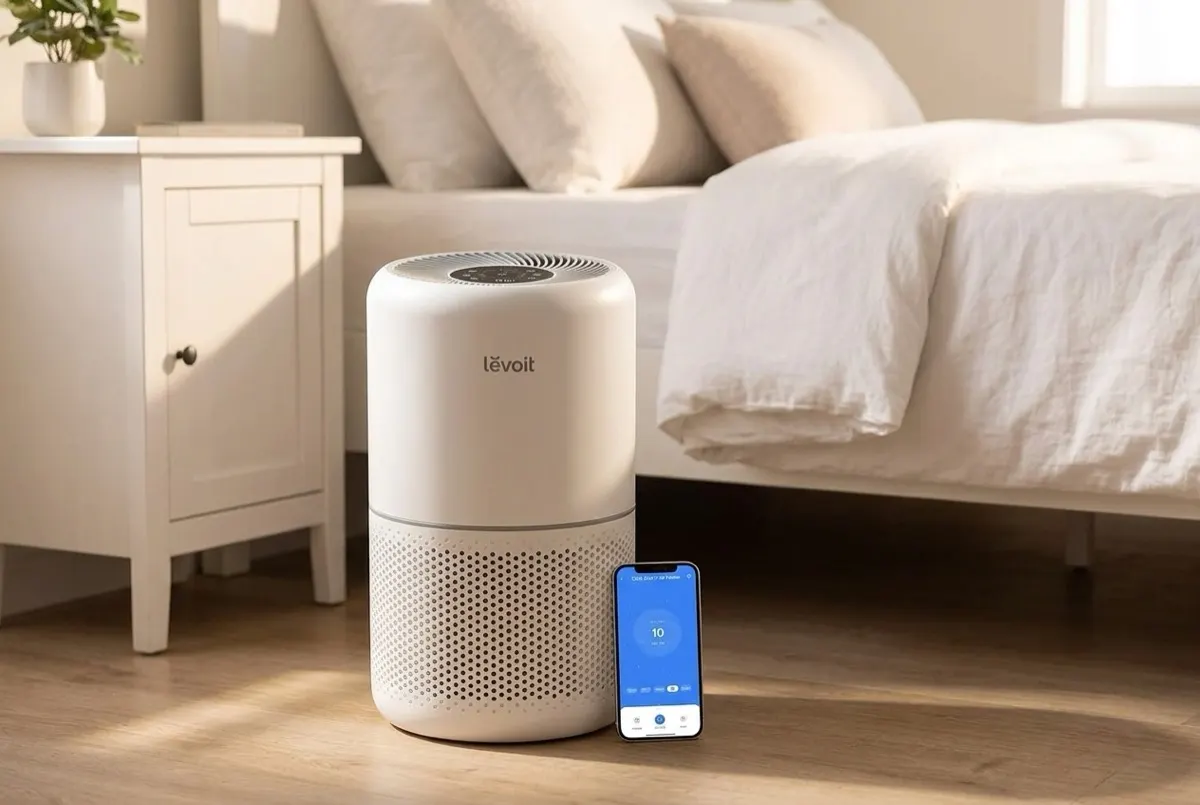
LEVOIT Core 300S Review: The Smart Small-Room HEPA Standard
219 sq ft (4.8 ACH)
3-stage True HEPA + Activated Carbon
141 CFM (smoke)
22-50 dB
Quick answer
The LEVOIT Core 300S is the Wi-Fi successor to the discontinued Core 300, with a 3-stage True HEPA filter rated for 99.97% of 0.3-micron particles and an AHAM Verifide 141 CFM smoke CADR. That covers about 219 sq ft at 4.8 air changes per hour, and the QuietKEAP sleep mode is rated at 22 dB. Smart control runs through the VeSync app with Alexa and Google Assistant support.
Methodology & sources
TestedThis review is backed by a validated long-term test record retained by Claire Fontaine.
Verified on August 8, 2026
Pros
- 3-stage True HEPA filtration in a compact 360-degree cylinder
- Adds Wi-Fi, auto mode and a timer the original Core 300 lacked
- QuietKEAP sleep mode rated by LEVOIT at 22 dB
- AHAM Verifide and Energy Star certified
Cons
- Coverage tops out around 219 sq ft for a true 4.8 air changes per hour
- Replacement filters are an ongoing consumable cost
- Smart features depend on the VeSync app and a 2.4GHz network
Best for
- Bedrooms, nurseries and home offices up to 219 sq ft
- Buyers who want app, Alexa and auto mode in a compact unit
- Anyone replacing the discontinued Core 300
Spec comparison
| Spec comparison | LEVOIT Core 300S | BLUEAIR Blue Pure 211i Max | BLUEAIR Blue Pure 311i Max |
|---|---|---|---|
| CADR | 141 CFM | 435 / 453 / 450 CFM (Smoke / Dust / Pollen, AHAM Verifide) | 283 / 314 / 365 CFM (Smoke / Dust / Pollen, AHAM Verifide) |
| Coverage | 219 sq ft (4.8 ACH); 1,051 sq ft (1 ACH) | 674 sq ft (4.8 ACH) | 439 sq ft (4.8 ACH) |
| Noise level | 22-50 dB | 23-53 dB | 23-50 dB |
| Power | 23 W | 46 W | 32 W |
| Filter type | 3-stage: pre-filter + main filter + activated carbon | HEPASilent dual filtration; Particle & Carbon main filter + washable fabric pre-filter | HEPASilent dual filtration; Particle & Carbon main filter + washable fabric pre-filter |
| Filter life | 6-8 months | 6-9 months (main filter); pre-filter washable | 6-9 months (main filter); pre-filter washable |
| Warranty | 2-year limited | 1 year limited; 3 years with product registration | 1 year limited; 3 years with product registration |
| Dimensions | 8.7 x 8.7 x 14.2 in | 22.7 x 14.4 x 14.4 in (H x W x D) | 19 x 12.5 x 12.5 in (H x W x D) |
| Weight | 5.95 lbs | 16.2 lbs | 7.8 lbs |
For years the LEVOIT Core 300 was the default answer to a simple question: what is the best small air purifier that does not cost a fortune and does not sound like a hairdryer? It sold in enormous numbers, sat on countless nightstands, and earned a reputation as the sensible starter unit for anyone dipping a toe into indoor air quality. That original model has now quietly slipped off the shelves, its listing discontinued. The unit that replaces it, and the one you should actually be shopping for today, is the Core 300S.
The letter matters. The "S" is LEVOIT's shorthand for a smart, Wi-Fi-connected version of an existing purifier, and in the case of the Core 300S it is not a cosmetic change. The chassis, the filter and the fundamental air-moving hardware are carried over almost unchanged from the model that made the platform famous, but the control layer on top of it has been rebuilt. That combination — a proven filtration core wrapped in modern connectivity — is exactly why this remains the small-room purifier to beat.
What actually changed from the Core 300
If you already know the Core 300, the fastest way to understand the 300S is to picture the same machine with a brain transplant. The physical dimensions are shared: a compact cylinder roughly 8.7 inches across and 14.2 inches tall, light enough to lift with one hand and move from a bedroom to a study without a second thought. The 360-degree intake, the top-mounted controls and the familiar drum-shaped filter all remain.
What LEVOIT bolted on is the part the original never had. The Core 300S adds full Wi-Fi connectivity through the VeSync app, along with Amazon Alexa and Google Assistant voice control. More importantly for day-to-day living, it introduces an auto mode driven by connected scheduling and a timer function. The plain Core 300 was a manual machine: you set a fan speed and it held that speed until you changed it. The 300S can be told to run on a schedule, ramp up before you get home, or drop to its sleep setting overnight, all without you touching the unit.
For a lot of buyers that is the difference between a purifier that gets used properly and one that gets left on a single speed forever. If you have ever forgotten to turn a purifier up during allergy season or down at bedtime, the scheduling alone justifies the step from the discontinued 300 to the 300S.
Filtration: what the three stages really do
The heart of any purifier is its filter stack, and here the Core 300S keeps the sensible three-stage design that made the original so easy to recommend.
Stage one is a fine-mesh nylon pre-filter. It is the unglamorous part, catching large debris — pet hair, human hair, lint and dust bunnies — before they reach the expensive media behind it. Keeping that junk off the main filter is what lets the pleated media last a full service interval instead of clogging early.
Stage two is the True HEPA filter, and this is the stage that earns the purifier its keep. LEVOIT rates the media to capture 99.97% of airborne particles down to 0.3 microns. That 0.3-micron figure is not marketing decoration; it is the most-penetrating particle size, the hardest diameter for a filter to trap. A filter that performs at 0.3 microns performs even better on larger and smaller particles, which is why the True HEPA standard is defined there. In practical terms that band covers the things that make small rooms miserable: pollen, fine dust, mold spores, pet dander and a good share of smoke particulate.
To keep the scale in mind: a human hair is roughly 50 to 70 microns thick. Pollen grains run from about 10 to 100 microns. The dander and fine particulate that trigger most indoor allergy symptoms live well below that, which is precisely the range a True HEPA filter is built to hold onto.
Stage three is an activated-carbon layer. Carbon does nothing for particles; instead it adsorbs gas-phase molecules, which is how a purifier tackles cooking smells, pet odor and light volatile organic compounds. The carbon in a compact unit like this is a coated layer rather than a deep bed of pellets, so treat it as an everyday-odor tool rather than a heavy-duty chemical scrubber. For a bedroom or a nursery, it is plenty.
The CADR math, honestly
This is where clear thinking separates a purifier that works from one that just hums in the corner. The Core 300S carries an AHAM Verifide Clean Air Delivery Rate of 141 CFM for smoke. CADR describes how much genuinely clean air the unit delivers per minute, verified by an independent body rather than the manufacturer's own lab.
To turn that into a room size that means something, use the rule this site applies to every purifier: take the smoke CADR and multiply by 1.5. That gives the square footage the unit can clean at roughly 4.8 air changes per hour — the cadence that actually matters for allergy relief, because it scrubs the full volume of a room about once every twelve or thirteen minutes.
- 141 CFM x 1.5 = about 211 square feet, which LEVOIT rounds to a 219 sq ft coverage figure.
You will also see a much larger number on the box — a coverage figure near 1,058 square feet. That is the same machine measured at a single air change per hour. One air change is enough to make the air technically "turned over" once every 60 minutes, but it is far too slow to keep pollen or smoke under control while you sleep. Read the big number as the absolute ceiling and the 219 sq ft figure as the honest working limit. Inside a standard bedroom, dorm room or enclosed home office, that is a comfortable match. Push it into a 400-square-foot open living area and the air simply moves through the filter too slowly to keep up.
Noise: built for the bedroom
A purifier destined for a nightstand lives or dies on its acoustic profile, and this is where the Core 300S plays to its strengths. LEVOIT's QuietKEAP design uses internal shock-absorbing pads to damp motor vibration, and on the dedicated sleep setting the company rates the unit as low as 22 decibels.
Twenty-two decibels is below the threshold of a quiet library and close to the sound of your own breathing. On sleep mode the display also dims, so there is no bright light ring keeping a light sleeper awake. Step up through the fan speeds and the sound rises predictably, reaching around 50 decibels flat out — audible, but a smooth rush of air rather than a mechanical whine, which is why so many owners run it as a white-noise source. For anyone who has unplugged a noisy purifier in frustration, the 300S is engineered to avoid exactly that fate.
Living with the smart features
The connected side is genuinely useful once the initial setup is done, though it is worth being clear-eyed about it. Pairing happens over a 2.4GHz Wi-Fi network through the VeSync app; a 5GHz-only router will refuse to connect, which trips up a fair number of first-time buyers. Once linked, the app becomes the reason to own the S model.
From your phone you can set schedules, flip the child lock, dim or kill the display, watch remaining filter life tick down, and switch fan speeds from anywhere. Voice control through Alexa or Google Assistant means you can drop the fan to sleep mode from bed without reaching for anything. The auto mode leans on scheduling and connected logic rather than an onboard particle sensor, so if a laser air quality reading is a must-have, look to a larger model in the range. For a set-and-forget bedroom purifier, the scheduling covers the same ground for most people.
Filters and the true cost of ownership
Buying a purifier is really buying into a filter subscription, and the Core 300S inherits the original's biggest hidden advantage: a deep catalog of swappable filters, all in the same drum format.
- The Original filter is the balanced all-rounder that ships in the box.
- The Toxin Absorber filter loads extra carbon for homes near heavy traffic, smog or wildfire smoke.
- The Pet Allergy filter uses a treated carbon formula aimed at ammonia and stubborn animal odor.
- The Smoke & Mold filter targets damp rooms and stale smoke.
That modularity lets you tune the machine to your specific problem instead of buying a different purifier. Plan on a full filter swap on roughly a yearly cycle under normal use, sooner in a dusty or smoky home. It is an unavoidable ongoing consumable cost, but LEVOIT's scale keeps replacements easy to find and the sensor-free filter-life estimate in the app takes the guesswork out of timing. Keep the pre-filter clean with a vacuum every few weeks and the main media will reach its full lifespan.
Setup, placement and upkeep
Getting the most out of the Core 300S has less to do with the machine and more to do with where it sits. The 360-degree intake is the design feature that gives you freedom here: because air is drawn in from every side of the cylinder rather than a single flat back panel, the unit does not need to be shoved against a wall. It works best out in the open, a foot or so clear of furniture, roughly central to the room and away from curtains or bedding that could block the base.
Height helps too. Airborne allergens do not distribute evenly; pollen and dust settle, while smoke and lighter particulate drift higher. Placing the unit on the floor or a low stool lets it pull the settling particles that a table-top position would miss, while the upward exhaust keeps clean air circulating through the breathing zone.
Setup itself is quick. Unwrap the filter from its plastic sleeve before the first run — a step a surprising number of owners forget, which starves the machine of airflow — then pair it in the VeSync app over a 2.4GHz network. From there the app walks through schedules and voice-assistant linking. Day to day, the maintenance rhythm is simple: vacuum the pre-filter every two to four weeks, wipe the intake grille when dust builds up, and swap the main filter when the app's filter-life indicator runs down. Resetting that indicator after a swap is a single tap, and it is the closest thing the sensor-free 300S has to telling you the air is being properly cleaned.
Who should buy the Core 300S
The Core 300S is the right call for a clearly defined buyer.
Bedroom and nursery owners are the core audience. In a room up to 219 square feet the 4.8-air-changes-per-hour figure is well matched, the 22-decibel sleep mode disappears into the background, and the dimming display keeps the room dark.
Anyone replacing a discontinued Core 300 should simply move up to the 300S rather than hunt for old stock. The filtration is equivalent, the price positioning is similar, and the added Wi-Fi, scheduling and voice control are a clear upgrade.
First-time buyers who value simplicity with a smart safety net get the best of both worlds: a purifier that runs happily on its own, plus an app for the moments you want control.
Who should skip it
Anyone furnishing a large or open-plan space will out-run this unit. A great room, a combined kitchen-and-lounge or any room past roughly 250 square feet needs a higher-CADR machine such as the LEVOIT Core 400S or a mid-size unit like the Coway Airmega Mighty2. Forcing a small purifier to cover a big room just gives you clean air near the unit and stale air everywhere else.
Buyers who want a purely manual, offline appliance are paying for connectivity they will never use. If you know you want one fan speed and nothing else, the smart hardware is wasted on you.
People chasing an onboard laser air quality display should look up the range, since the 300S leans on scheduling rather than a particle sensor for its automation.
How it compares
Against its own step-up sibling, the Core 400S, the picture is straightforward: the 400S roughly doubles the CADR, adds a laser dust sensor with a numeric readout, and covers a much larger room, at the cost of a bigger footprint and a higher price position. If your room fits inside 219 square feet, that extra capability is money spent on headroom you will not use.
Against a mid-size platform like the Coway Airmega Mighty2, the 300S is smaller, quieter at its floor and cheaper to run, but it cannot match the Coway's larger coverage or onboard laser sensing. Think of the 300S as the specialist for one room done right, and the mid-size machines as the generalists for a whole living space.
Energy use and running it around the clock
Because a purifier only works when it is actually running, the sensible way to use the Core 300S is to leave it on continuously, and its efficiency makes that painless. The unit carries an Energy Star listing, and on its lower and sleep speeds — where it spends most of its life in a bedroom — the draw is modest enough that running it every hour of every day has a negligible effect on an electricity bill. The bigger lever on running cost is the filter, not the power.
Leaning on the sleep and lower speeds rather than parking it on high keeps both the energy use and the filter wear down, and the app's scheduling makes it easy to drop the fan automatically overnight and lift it again during the day. Treated this way, the Core 300S becomes a genuine set-and-forget appliance: quiet, cheap to run, and always working in the background rather than switched off and forgotten in a closet.
Verdict
The Core 300S does not reinvent the small purifier so much as perfect the formula that made its predecessor a default recommendation. It keeps the compact body, the genuinely effective 3-stage True HEPA filtration and the sleep-friendly 22-decibel floor, then adds the Wi-Fi, scheduling and voice control that turn a good bedroom purifier into an effortless one.
Its limits are honest and easy to plan around: it is a small-room device, its automation relies on the app rather than an onboard sensor, and — like every purifier — it carries an ongoing filter cost. Accept those and match it to a room inside 219 square feet, and the Core 300S is the clearest, safest small-room purifier recommendation on the market today, and the natural home for anyone whose trusty Core 300 has finally been retired. For the cost of a mid-range appliance, it delivers genuine True HEPA filtration, a whisper-quiet night and set-and-forget automation that ensures the air actually gets cleaned rather than the machine getting ignored, which is the only measure of a purifier that ultimately matters.
Editorial summary
LEVOIT Core 300S review: the smart successor to the Core 300 with 3-stage True HEPA, a 141 CFM smoke CADR, 219 sq ft coverage and a 22 dB sleep mode.
Where to buy
Check the merchant for the current price and availability. We may earn a commission.