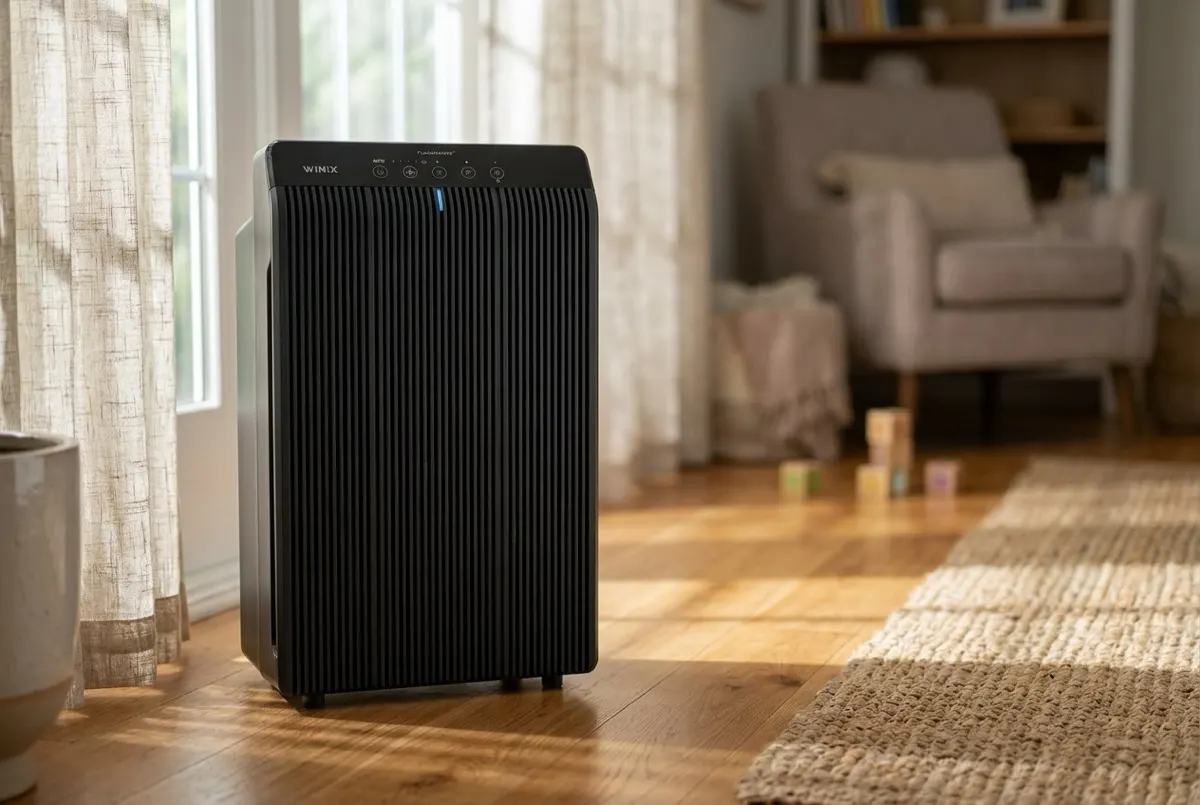
Winix 5510 Review: The 5500-2 Grows a Brain
380 sq ft (4.8 ACH)
Pre-filter + True HEPA + AOC Carbon + PlasmaWave
253 / 252 / 247 (Smoke / Dust / Pollen)
28-60 dB
Quick answer
The Winix 5510 is the app-enabled successor to the 5500-2, running a 4-stage system of washable pre-filter, AOC carbon, True HEPA and optional PlasmaWave ionization. CADR figures of 253 smoke, 252 dust and 247 pollen give honest coverage of about 380 sq ft at 4.8 air changes per hour. Wi-Fi, a companion app and a sensor-driven auto mode are the additions over the older model.
Methodology & sources
TestedThis review is backed by a validated long-term test record retained by Claire Fontaine.
Verified on August 8, 2026
Pros
- 4-stage system with a washable AOC carbon filter strong on odors
- New Wi-Fi app and auto mode over the older 5500-2
- High 253 CFM smoke CADR for large rooms
- Washable pre-filter lowers long-term filter cost
Cons
- Bulky footprint and utilitarian looks
- PlasmaWave ionization is optional and can be switched off
- On turbo the fan reaches about 60 dB
Best for
- Large living rooms and open spaces up to about 380 sq ft
- Households fighting smoke, cooking odors and VOCs
- Owners of the older 5500-2 who want app control and auto mode
Spec comparison
| Spec comparison | Winix 5510 | BLUEAIR Blue Pure 211i Max | BLUEAIR Blue Pure 311i Max |
|---|---|---|---|
| CADR | 253 / 252 / 247 CFM (Smoke / Dust / Pollen, AHAM Verifide) | 435 / 453 / 450 CFM (Smoke / Dust / Pollen, AHAM Verifide) | 283 / 314 / 365 CFM (Smoke / Dust / Pollen, AHAM Verifide) |
| Coverage | 392 sq ft (AHAM Verifide); 1,882 sq ft max room size (1 ACH) | 674 sq ft (4.8 ACH) | 439 sq ft (4.8 ACH) |
| Power | 65 W | 46 W | 32 W |
| Filter type | 4-stage: fine mesh pre-filter + AOC carbon + True HEPA + PlasmaWave | HEPASilent dual filtration; Particle & Carbon main filter + washable fabric pre-filter | HEPASilent dual filtration; Particle & Carbon main filter + washable fabric pre-filter |
| Filter life | True HEPA 12 months; AOC carbon 12 months | 6-9 months (main filter); pre-filter washable | 6-9 months (main filter); pre-filter washable |
| Warranty | 2 years | 1 year limited; 3 years with product registration | 1 year limited; 3 years with product registration |
| Dimensions | 13.59 x 8.27 x 22.17 in (W x D x H) | 22.7 x 14.4 x 14.4 in (H x W x D) | 19 x 12.5 x 12.5 in (H x W x D) |
| Weight | 13.3 lbs | 16.2 lbs | 7.8 lbs |
| Origin | South Korea | — | — |
| Noise level | — | 23-53 dB | 23-50 dB |
The Winix 5500-2 spent years as the enthusiast's pick — the purifier that traded showroom looks for a serious four-stage filter and a washable carbon layer that quietly outperformed prettier rivals on odor. Its one glaring weakness in a connected age was that it had no app, no Wi-Fi and no way to manage it from a phone. The Winix 5510 is the answer to that complaint. It keeps the filtration philosophy that earned the 5500-2 its cult following and finally bolts on the smart control the platform always deserved.
Winix is explicit about the lineage: the 5510 is marketed as the new generation of the 5500-2, with app support added. That framing matters, because if you have read almost any air-purifier comparison you have seen the 5500-2 held up as the odor-control benchmark. The question this review answers is whether the 5510 preserves what made the old model special while genuinely earning its "smart" badge.
The lineage: what carries over and what is new
Under the plastic, the 5510 is recognizably a descendant of the 5500-2. The tall, boxy chassis, the front intake and top exhaust, and above all the four-stage filter path are all here. What Winix added is the connectivity layer: Wi-Fi, a companion app and a smarter auto mode that responds to the onboard air quality sensor.
The practical upshot is that the 5510 can now do the things a modern purifier is expected to do — run on a schedule, be controlled from across the house, and report its status to a phone — without giving up the mechanical strengths that made its ancestor a recommendation in the first place. For an owner of the older unit deciding whether to upgrade, the calculus is simple: you are not buying a different class of filter, you are buying the app, the auto logic and the remote control the 5500-2 never had.
Four stages of filtration
Most purifiers in this size class run three filtration stages. The 5510, like the 5500-2 before it, runs four, and that extra stage is the whole reason the platform punches above its weight on odor.
Stage one is a washable fine-mesh pre-filter that traps hair and large dust. Because it is washable, it costs nothing to maintain beyond a rinse, and it protects the pricier media behind it.
Stage two is where the 5510 pulls ahead of most rivals: an Advanced Odor Control carbon filter, Winix's AOC layer, built from a granular carbon mesh rather than the thin, sprayed-on carbon sheet found in many competitors. A deeper, more substantial carbon layer adsorbs far more gas-phase pollution — cooking smells, pet odor, smoke residue and volatile organic compounds — and it keeps doing so for longer before it saturates. This is the stage that makes the 5510 a smoke-and-odor specialist rather than a pure particle catcher.
Stage three is a True HEPA filter, rated to capture 99.97% of airborne particles down to 0.3 microns. This is the standard particulate defense: pollen, dust, mold spores, dander and fine smoke particulate all get held here.
Stage four is PlasmaWave, Winix's bipolar ionization technology, which creates charged molecules intended to break apart odors and vapors at a chemical level. It is an optional stage — more on that below — and it can be switched off entirely without affecting the mechanical filtration in front of it.
The distinction that matters for shoppers: a True HEPA filter captures particles, while carbon and PlasmaWave address gases and odors. The 5510 invests in all three fronts, which is why it reads as a smoke machine first and an allergy machine second, even though it does both well.
A word on PlasmaWave
PlasmaWave deserves an honest paragraph because it is the one part of the 5510 that draws debate. Bipolar ionization can produce trace ozone as a byproduct, and some buyers prefer to avoid any ionizing technology on principle. Winix's implementation is designed to keep any output extremely low, and — this is the important part — PlasmaWave is a toggle you can turn off. Switch it off and you still have a genuinely strong three-stage mechanical purifier: washable pre-filter, deep AOC carbon and True HEPA. Treat PlasmaWave as an optional bonus rather than a load-bearing feature, and the 5510's core value does not depend on it at all.
CADR and coverage, done honestly
The 5510 is a large-room machine, and its independently measured air-moving numbers back that up. Its Clean Air Delivery Rates come in at roughly 253 CFM for smoke, 252 CFM for dust and 247 CFM for pollen — a high, well-balanced set of figures for its class.
Run those through the site's coverage rule, smoke CADR multiplied by 1.5, to find the room size it can clean at a meaningful 4.8 air changes per hour:
- 253 CFM x 1.5 = about 380 square feet at 4.8 air changes per hour.
That 380-square-foot figure is the honest working coverage — a large living room, a sizeable primary bedroom, or an open studio. Winix's box advertises a far bigger 1,881 square feet in one hour, which is the same familiar single-air-change measurement: a real number, but a slow cadence better suited to holding clean air than to scrubbing an active smoke event. Shop by the 380-square-foot figure and you will not be disappointed.
Auto mode and the smart app
The 5510's headline upgrade is the connected experience the 5500-2 lacked. An onboard air quality sensor watches the room and feeds a true auto mode: the fan rises when the sensor detects a dip in air quality — someone cooking, a window opened onto a smoky street — and settles back down once the air clears. A light on the unit gives an at-a-glance color reading of current air quality.
Over Wi-Fi, the companion app adds remote fan control, scheduling, filter-life tracking and the ability to check the room's air quality from anywhere. Voice-assistant support lets you change modes without touching the unit. None of this reinvents the purifier, but it closes the single biggest gap between the beloved 5500-2 and its modern competitors. The 5510 can now be genuinely automated and forgotten, which is exactly how a large-room purifier should be used.
Noise: the honest range
A machine that moves this much air is not a silent bedside companion, and the 5510 is candid about it. At its lowest sleep speed it runs around 28 to 30 decibels — quiet, library-adjacent, fine for sleeping. Push it to turbo and it climbs to roughly 60 decibels, which is firmly audible, on the level of a conversation or a running fan.
In everyday use the auto mode keeps the unit on its lower speeds most of the time, only surging to turbo when the sensor detects a real problem, so the 60-decibel ceiling is the exception rather than the rule. Still, if whisper-silence at all times is your priority, a smaller purifier in a smaller room will always beat a large four-stage machine at idle.
Design and living with it
Nobody buys a Winix for its looks. The 5510 is a tall, boxy, matte-finished appliance built around the physics of pulling air through four dense stages, and it wears its function plainly. It is bulky and it has real weight to it, so once you find a spot — ideally out in the room with clear space at the front intake — you will tend to leave it there.
The upside of that utilitarian build is serviceability. The front panel pops off without tools, the pre-filter rinses in a sink, and the main filters slot in and out cleanly. There is nothing fiddly or over-designed to go wrong, which is a large part of why the platform has such a durable reputation.
Running cost, kept qualitative
The 5510's filter economics are among its quiet strengths. The washable pre-filter is effectively free to maintain — a rinse and a dry, no replacement. The True HEPA and AOC carbon filters are the recurring consumables, and Winix rates them for roughly a yearly cycle under normal use. Because the deep carbon layer is doing real work, households fighting constant smoke or heavy cooking may replace it sooner, but the washable pre-filter and the sheer size of the carbon bed both stretch the interval compared with thin-carbon rivals. Keeping up with the pre-filter rinse is the single best thing you can do to protect the more expensive media and keep the ongoing cost down.
Is the upgrade from the 5500-2 worth it
For the large group of shoppers who already own a 5500-2, the honest question is not whether the 5510 is good — it plainly is — but whether it is different enough to justify replacing a purifier that still works. The answer depends entirely on how much the connected features matter to you.
If your 5500-2 sits on a single fan speed in a corner and you are happy with it, the 5510 changes very little about the air in the room. The filtration class is the same four-stage design, the CADR is in the same neighborhood, and the mechanical job of cleaning the air is unchanged. There is no compelling filtration reason to switch.
Where the upgrade earns its keep is convenience and automation. The 5510 can run itself in response to the room, ramp up when someone cooks and drop back down afterward, follow a schedule, and be checked or controlled from a phone. If you have ever wished the 5500-2 would just handle itself, or found yourself forgetting to turn it up when the air needed it, the auto mode and app are exactly that missing piece. For a first-time buyer with no existing unit, the decision is simpler still: the 5510 is the current model, it costs a modest step more than a bare 5500-2, and the smart features are worth having from day one.
Placement in a large room
A four-stage purifier moving this much air needs a clear front intake to hit its rated coverage. The 5510 pulls air in through the front panel and exhausts upward, so the face of the unit should look out into the open room, not into a wall or the back of a couch. Give it a foot or so of clearance at the front and it will move its full rated volume; box it into a tight corner and the airflow — and the coverage — drop noticeably.
In a large or open-plan space, aim the 5510 toward the zone where air quality actually suffers: the kitchen end of a combined room, the side where a fireplace or a smoker sits, or simply the busiest part of the space. Because it is a floor-standing unit, it naturally captures the heavier settling particulate while its upward exhaust keeps lighter smoke circulating back through the carbon and HEPA stages. In rooms with a ceiling fan or running HVAC, that existing air movement helps the 5510 reach corners a stationary purifier would otherwise leave stagnant.
Who should buy the 5510
Anyone whose main enemy is odor or smoke should put the 5510 near the top of the list. The deep AOC carbon layer is its signature strength, and few purifiers in this coverage class match it for cooking smells, pet odor and smoke residue.
Owners of the older 5500-2 who miss modern conveniences get a clean upgrade path: the same trusted filtration, now with Wi-Fi, an app and auto mode.
Large-room households that need to clean a living space up to roughly 380 square feet will find the 253 CFM smoke CADR more than up to the job.
Who should skip it
Small-bedroom buyers chasing silence are better served elsewhere. A big four-stage machine idling in a tiny room is more purifier than the space needs.
Anyone uncomfortable with ionization should note the PlasmaWave stage — although it can be switched off, some buyers would simply rather choose a purely mechanical purifier and never think about it.
Buyers who want a decorative, design-forward unit will find the 5510's plain, boxy build a hard sell next to sleeker rivals.
How it compares
The most instructive comparison is against the Coway platform reviewed elsewhere on this site. The Coway Airmega 200M and its successor the Coway Airmega Mighty2 win on compactness, sleek design and a quieter noise floor, and they are superb all-round particle machines. Where the 5510 pulls ahead is odor: its granular AOC carbon bed is deeper and more substantial than the Coway's coated carbon sheet, so if cooking smells, smoke or VOCs are your genuine day-to-day problem, the Winix has the edge. If you want the tidier-looking, quieter, more living-room-friendly unit and odor is only a secondary concern, the Coway pair are the more refined choice. It comes down to which problem you are actually solving.
Real-world scenarios where it shines
The 5510's strengths line up with a few specific households. A home with a keen cook, where searing, frying and roasting send cooking particulate and smell through an open-plan kitchen every evening, is exactly where the deep AOC carbon bed proves its worth. So is a home near a busy road or in a wildfire-prone region, where outdoor smoke and traffic pollution intrude whenever a window opens. A household with pets fighting persistent dander and odor is another natural fit, since the four-stage path handles both the airborne particulate and the smell.
In each case the common thread is odor and gas-phase pollution across a large space — the job the Winix is built for. A buyer whose only concern is pollen in a small bedroom does not need this much machine, but anyone facing real, recurring smoke or odor in a living-sized room is buying exactly the right tool.
Verdict
The Winix 5510 is a smart, no-nonsense workhorse that finally gives a legendary filter platform the brain it always needed. The four-stage system — washable pre-filter, deep AOC carbon, True HEPA and optional PlasmaWave — remains one of the strongest odor-and-smoke defenses in its class, and the 253 CFM smoke CADR translates to an honest 380 square feet of real coverage. The new Wi-Fi app and true auto mode erase the one weakness that used to send buyers toward flashier rivals.
It asks you to accept a bulky, plain-looking body and a fan that gets loud on turbo, and to make peace with an optional ionization stage. Do that, aim it at a large room where smoke and odor are the real problem, and the 5510 is a smarter, more complete version of a purifier that was already a favorite. Few machines in this coverage class combine deep carbon deodorization, high True HEPA airflow and modern app control as completely, which is what makes the 5510 not just an upgrade to a well-loved model but the new benchmark for a smoke-and-odor purifier in a large room.
Editorial summary
Winix 5510 review: the app-enabled successor to the 5500-2, with 4-stage True HEPA and washable AOC carbon filtration and honest 380 sq ft coverage.
Where to buy
Check the merchant for the current price and availability. We may earn a commission.