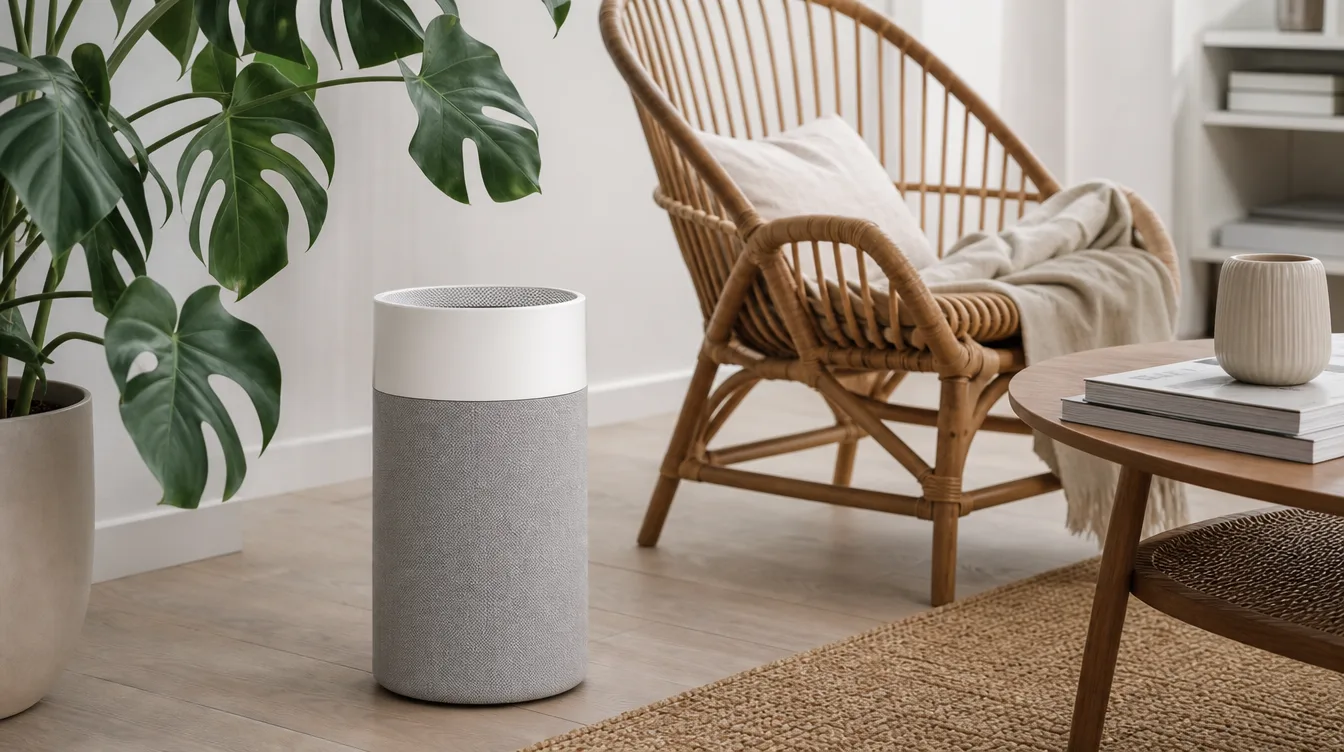
BLUEAIR Blue Pure 311i Max Review: The Quiet Non-LEVOIT Pick?
439 sq ft (4.8 ACH)
HEPASilent dual (mechanical + electrostatic), particle + carbon
283 / 314 / 365 CFM (Smoke / Dust / Pollen)
23-50 dB (rated)
Methodology & sources
TestedThis review is backed by a validated long-term test record retained by Claire Fontaine.
Verified on August 8, 2026
Pros
- HEPASilent dual filtration moves a lot of air for very low power draw
- Genuinely quiet on its lower speeds, well suited to a bedroom
- Onboard air-quality sensor with a responsive auto mode
- The first non-LEVOIT pick on this site, adding brand diversity
Cons
- The electrostatic stage cannot be switched off and produces trace ozone
- Smart features need the Blueair app and a Blueair account over Wi-Fi
- At full speed it is clearly audible, with HouseFresh measuring close to 58 dBA
- Only one combined particle-and-carbon filter, not a deep dedicated carbon bed
Best for
- Quiet operation in a medium bedroom or living room up to about 439 sq ft
- Buyers who want high airflow for very low power draw
- Anyone wanting a capable non-LEVOIT pick to break single-brand risk
Spec comparison
| Spec comparison | BLUEAIR Blue Pure 311i Max | BLUEAIR Blue Pure 211i Max | Coway Airmega 200M |
|---|---|---|---|
| CADR | 283 / 314 / 365 CFM (Smoke / Dust / Pollen, AHAM Verifide) | 435 / 453 / 450 CFM (Smoke / Dust / Pollen, AHAM Verifide) | 246 / 249 / 277 CFM (Smoke / Dust / Pollen) |
| Coverage | 439 sq ft (4.8 ACH) | 674 sq ft (4.8 ACH) | 361 sq ft (4.8 ACH); 874 sq ft (2 ACH); 1,748 sq ft (1 ACH) |
| Noise level | 23-50 dB | 23-53 dB | 24.4-55.1 dB(A) |
| Power | 32 W | 46 W | 82 W |
| Filter type | HEPASilent dual filtration; Particle & Carbon main filter + washable fabric pre-filter | HEPASilent dual filtration; Particle & Carbon main filter + washable fabric pre-filter | Pre-filter + deodorization filter + HEPA filter + bipolar device |
| Filter life | 6-9 months (main filter); pre-filter washable | 6-9 months (main filter); pre-filter washable | Deodorization filter 6 months; HEPA filter 12 months |
| Warranty | 1 year limited; 3 years with product registration | 1 year limited; 3 years with product registration | 1 year (parts); 3 years (motor and electronic parts) |
| Dimensions | 19 x 12.5 x 12.5 in (H x W x D) | 22.7 x 14.4 x 14.4 in (H x W x D) | 16.8 x 18.3 x 9.6 in (W x H x D) |
| Weight | 7.8 lbs | 16.2 lbs | 12.3 lbs |
If you want a quiet, low-power purifier for a medium bedroom and you would rather not add a sixth LEVOIT to the shelf, the BLUEAIR Blue Pure 311i Max is the model to shortlist. It is the first non-LEVOIT pick on this site, and it earns the spot on merit: Blueair's HEPASilent filtration moves a large volume of air while sipping electricity, and on its lower speeds it is genuinely quiet, the trait that matters most in a room you sleep in. Based on published specifications and the independent testing consensus, it is one of the easiest quiet purifiers to recommend for a medium room.
Who should skip it? Anyone who wants a purifier with no ionization at all, because the 311i Max's electrostatic stage cannot be turned off; and anyone unwilling to create a Blueair account, since the app-based smart features depend on it. For most buyers who simply want clean, quiet air in a bedroom or medium living room, those are minor caveats rather than dealbreakers.
Why HEPASilent matters
HEPASilent is the reason the 311i Max exists as a distinct choice. A conventional purifier forces all the air through a dense HEPA filter, which is effective but costs fan power and noise. Blueair's approach charges incoming particles with an electrostatic field first, then catches them in a lighter, less restrictive filter. The payoff is real: the machine can push a high volume of clean air while drawing very little electricity and staying quiet. HouseFresh measured a maximum draw of only about 29 watts at top speed, remarkably frugal for the airflow on offer.
The trade-off is the part every honest review has to state plainly. That electrostatic stage is a form of ionization, and unlike the switchable PlasmaWave stage on the Winix 5510, it cannot be disabled on the 311i Max. Ionization can produce trace ozone as a byproduct. Blueair engineers the output to stay very low, and independent bodies have generally found Blueair units well within safe limits, but if a purely mechanical purifier with no ionization whatsoever is what you want, that is the reason to look at the Coway Airmega Mighty2 instead, which keeps its air path ionizer-free.
CADR and the honest room-size math
Blueair publishes an AHAM-rated Clean Air Delivery Rate of 283 CFM for smoke, with 314 CFM for dust and 365 CFM for pollen. AHAM figures are measured by an independent body rather than the manufacturer's own lab, which is why they are the numbers to shop by.
Apply the coverage rule this site uses for every purifier: multiply the smoke CADR by 1.5 to find the area the unit can clean at a meaningful 4.8 air changes per hour.
- 283 CFM x 1.5 = about 425 square feet at 4.8 air changes per hour.
Blueair's own 4.8-ACH figure lands at 439 square feet, essentially the same answer, and that is the honest working size: a medium living room or a large bedroom. The box, meanwhile, advertises coverage up to 2,107 square feet. That headline is the same machine measured at a single air change per hour, a slow cadence for holding already-clean air rather than knocking down an active problem. Treat 2,107 square feet as the theoretical ceiling and roughly 439 square feet as the room where the 311i Max does its best work. (New to these numbers? The how to choose an air purifier guide walks through CADR, ACH and coverage.)
What "quiet enough" costs you in coverage
A CADR figure is measured at a unit's loud top speed, and clean-air delivery falls as the fan slows. HouseFresh put numbers on this for the 311i Max: at full speed it estimated a PM1 CADR around 220 CFM, but in the quiet band below 45 dBA — the level you would actually tolerate overnight — that dropped to roughly 108 CFM. Run through the same 1.5 rule, that quiet-speed figure is closer to a 160-square-foot unit than a 439-square-foot one.
The takeaway is not that the 311i Max underperforms. HouseFresh recorded it clearing its 728-cubic-foot test chamber of fine particulate in about 27 minutes at full speed, quick for its class. The point is to size it honestly: run it in a medium bedroom and it stays whisper-quiet while keeping the air clean; ask it to cover a full 439-square-foot living room and you will need to run it a speed or two higher when air quality dips.
The sensor, auto mode and the app
The 311i Max carries an onboard particulate sensor that drives a color-changing air-quality ring and a genuine auto mode: it raises and lowers fan speed on its own to chase the air back to clean, then eases off. Over Wi-Fi, the Blueair app adds remote control, scheduling, air-quality history and filter-life tracking through Blueair's RealTrack algorithm.
One practical note worth knowing before purchase: the app, and the smart features it unlocks, require a Blueair account. The unit runs perfectly well as a standalone appliance using its physical controls, so the account is only a gate on the connected features, not on the purifier itself. HouseFresh reported a smooth app setup with no connection trouble. If creating an account to schedule a purifier is a dealbreaker, the onboard button still gives you speed control and auto mode without it.
Filtration depth and odor
The 311i Max runs a single combined filter that pairs the particle media with a layer of activated carbon for light odors and volatile organic compounds. That is enough for everyday cooking smells and general freshness, but it is a coated-carbon approach rather than the deep pellet or granular carbon bed found in dedicated odor machines like the Winix 5510 or the LEVOIT Vital 200S-P. If heavy, constant odor — a serious smoker, a busy kitchen, litter-box smell — is the specific problem you are solving, a purifier built around a thicker carbon stage will hold up longer between filter changes. For particulate first and odor second, the 311i Max's combined filter is well judged. Blueair rates it for up to nine months, and the app counts down to the swap.
Running cost, kept qualitative
Two things keep the 311i Max cheap to live with. First, the low power draw: at roughly 29 to 32 watts on full and far less on its everyday lower speeds, it is one of the more frugal purifiers in its coverage class, and the auto mode keeps it from running hard when the air is already clean. Second, the long filter interval: a single combined filter on a cycle of up to nine months means fewer swaps than the multi-filter stacks some rivals use. The one recurring expense to plan for is that combined filter, and the app's RealTrack counter prompts you well before airflow suffers. Households with heavy odor or smoke will replace it sooner, since the carbon saturates faster than the particle media wears out.
Noise and design
Blueair rates the 311i Max from a sleep-mode floor near 23 decibels up to about 50 decibels at full speed. Independent measurement is a little less flattering at the top: HouseFresh recorded 37 dBA on the lowest speed and 57.7 dBA flat out. That top figure is clearly audible, conversation-level, but the character is a smooth rush, and in a bedroom the sensible move is to let auto mode sit on the lower, near-silent speeds and only surge when needed.
The design is the other reason people choose a Blueair. The 311i Max is a compact, cylindrical unit weighing under eight pounds, with a washable fabric pre-filter, and it blends into a room rather than announcing itself. It pulls air in through the sides and exhausts up through the top, so it wants a little clearance all around rather than being pushed into a corner.
The third-party consensus
Because this site does not run a lab, the honest way to judge a purifier is to aggregate the independent testers who do. HouseFresh's measurements are the backbone of this review: the roughly 29-watt power draw, the 27-minute clean-down of its test chamber, the 108 CFM quiet-speed delivery and the 57.7 dBA top-speed noise all come from its bench. The consistent thread is a quiet, efficient medium-room purifier whose main asterisk is the always-on ionization rather than any shortfall in cleaning.
Who should buy it
Bedroom and medium-room buyers who value quiet are the target. On its lower speeds the 311i Max is near-silent, and its auto mode spends most of its time there.
Efficiency-minded owners who dislike leaving a purifier running on high get one of the most power-frugal units in the class, with a long filter interval to match.
Anyone breaking single-brand risk on an all-LEVOIT shelf gets a genuinely capable Blueair alternative rather than a compromise.
Who should skip it
Ionization-averse buyers should note that the electrostatic stage cannot be switched off. Anyone who wants a purely mechanical air path should choose the Coway Airmega Mighty2 instead.
Heavy-odor households that need deep, durable carbon will be better served by the granular carbon bed of the Winix 5510.
How it compares
Against the LEVOIT Vital 200S-P, the 311i Max covers a similar-sized room and wins on quietness, power draw and design, while the Vital counters with a deeper pellet-carbon odor bed and a feature set with no permanent ionization. Against the Winix 5510, the Winix moves into larger-room, heavy-odor territory with its deep carbon stage and an ionizer you can switch off, whereas the Blueair is the quieter, more design-forward, lower-power choice for a medium room. And against the Coway Airmega Mighty2, the Coway is the pick for anyone who wants zero ionization in the air path, while the Blueair trades that for higher airflow per watt. For a fuller shortlist across every use case, see the best air purifiers guide.
Verdict
The BLUEAIR Blue Pure 311i Max is the site's first non-LEVOIT recommendation, and it earns the place by being the quiet, efficient specialist the catalog lacked. Its HEPASilent filtration delivers a lot of clean air per watt, its AHAM-rated 283 CFM smoke CADR translates to an honest 439 square feet of coverage, and on its lower speeds it is quiet enough to forget in a bedroom. The compromises are specific and worth weighing: an electrostatic stage that cannot be turned off and makes trace ozone, a smart layer that needs a Blueair account, and a single combined filter rather than a deep carbon bed. Accept those, size it to a medium room, and the 311i Max is one of the easiest quiet purifiers to recommend, and a welcome break from an all-LEVOIT shelf.
Editorial summary
A full review of the BLUEAIR Blue Pure 311i Max, covering its HEPASilent dual filtration, AHAM-rated 283 CFM smoke CADR, quiet auto mode, long filter interval and always-on electrostatic stage.
Where to buy
Check the merchant for the current price and availability. We may earn a commission.