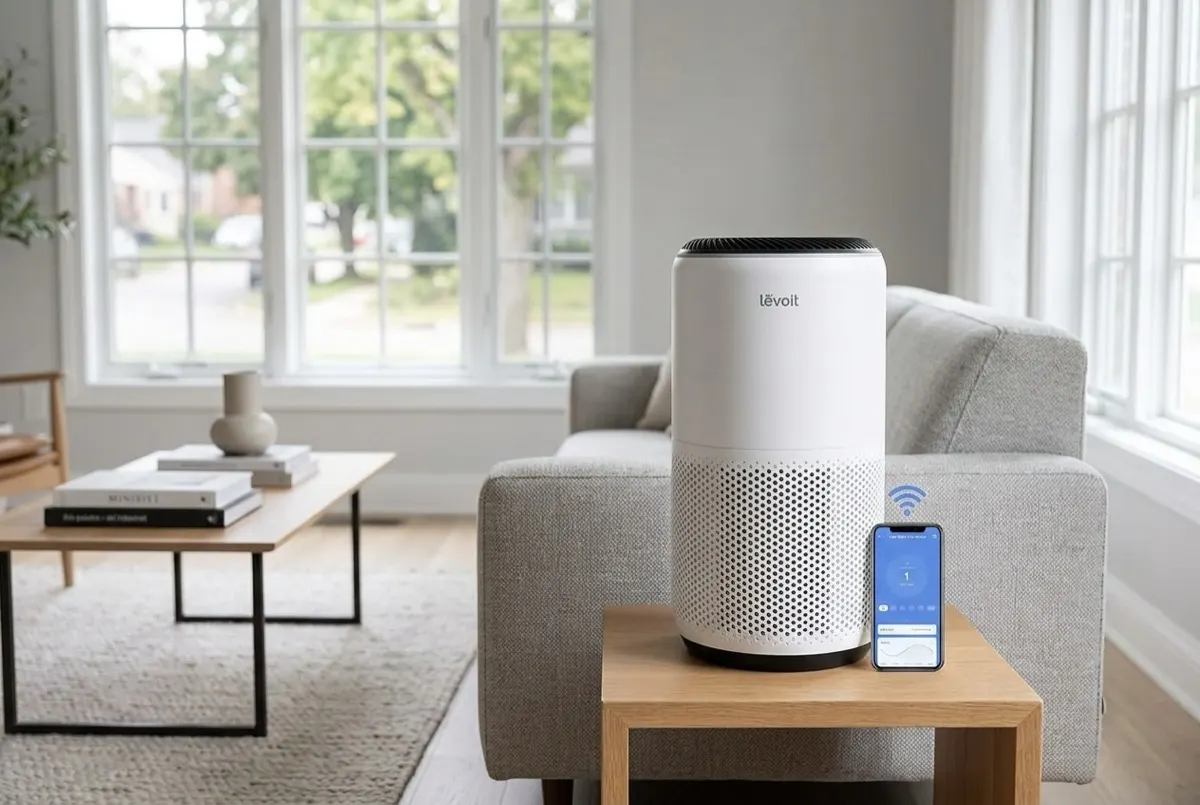
LEVOIT Core 400S Review: Big-Room HEPA With a Laser Sensor
347 sq ft (4.8 ACH)
3-in-1 H13 True HEPA + Activated Carbon
231 / 240 / 259 (Smoke / Dust / Pollen)
24-52 dB
Methodology & sources
TestedThis review is backed by a validated long-term test record retained by Claire Fontaine.
Verified on August 8, 2026
Pros
- H13 True HEPA rated to 99.97% at 0.3 microns
- AirSight Plus laser sensor shows a live PM2.5 figure
- Reliable auto mode with smart Wi-Fi via VeSync
- Strong 231 CFM smoke CADR for rooms up to 1,733 sq ft at one air change
Cons
- Physically large and heavier than compact tower purifiers
- Replacement 3-in-1 filters are an ongoing consumable cost
- On high speed the fan is clearly audible at 52 dB
Best for
- Living rooms and large bedrooms up to about 350 sq ft
- Buyers who want a numeric PM2.5 display and true auto mode
- Homes with pets, pollen or wildfire smoke
Spec comparison
| Spec comparison | LEVOIT Core 400S | BLUEAIR Blue Pure 211i Max | BLUEAIR Blue Pure 311i Max |
|---|---|---|---|
| CADR | 234 / 233 / 257 CFM (Smoke / Dust / Pollen, AHAM Verifide) | 435 / 453 / 450 CFM (Smoke / Dust / Pollen, AHAM Verifide) | 283 / 314 / 365 CFM (Smoke / Dust / Pollen, AHAM Verifide) |
| Coverage | 358 sq ft (4.8 ACH); 1,718 sq ft (1 ACH) | 674 sq ft (4.8 ACH) | 439 sq ft (4.8 ACH) |
| Noise level | 22-52 dB | 23-53 dB | 23-50 dB |
| Power | 38 W | 46 W | 32 W |
| Filter type | 3-stage: pre-filter + main filter + activated carbon | HEPASilent dual filtration; Particle & Carbon main filter + washable fabric pre-filter | HEPASilent dual filtration; Particle & Carbon main filter + washable fabric pre-filter |
| Filter life | 12 months | 6-9 months (main filter); pre-filter washable | 6-9 months (main filter); pre-filter washable |
| Warranty | 2-year limited | 1 year limited; 3 years with product registration | 1 year limited; 3 years with product registration |
| Dimensions | 10.8 x 10.8 x 20.5 in | 22.7 x 14.4 x 14.4 in (H x W x D) | 19 x 12.5 x 12.5 in (H x W x D) |
| Weight | 11 lbs | 16.2 lbs | 7.8 lbs |
Most people meet LEVOIT through one of its little cylindrical bedroom purifiers and assume the brand tops out somewhere around a nightstand. The Core 400S is the machine that corrects that impression. It is the model you buy when a compact unit has run out of room — when the space in question is a living room, a large primary bedroom, or an open kitchen-and-lounge where a small purifier would clean the air near itself and leave the far corners untouched. It pairs a genuinely large-room air-moving capacity with a laser dust sensor and a numeric readout, and it does so without leaving LEVOIT's famously approachable price bracket.
The catch, and there is always a catch, is size. This is a substantial appliance, and it is not the unit you want humming beside a small bed. Understanding where the 400S fits — and where it is overkill — is the whole job of this review.
Positioning: where the 400S sits in the range
Think of LEVOIT's smart line as a ladder. The compact LEVOIT Core 300S handles a single bedroom or office up to roughly 219 square feet. The 400S sits a decisive rung higher, built for the rooms most households actually spend their waking hours in.
The jump between the two is not incremental. The 400S roughly doubles the clean-air output of the 300S, adds a real laser particle sensor where the smaller unit relies on scheduling, and grows a taller, wider body to house a much larger filter. If your problem is a bedroom, the 300S is the smarter spend. If your problem is a living room, the 400S is the entry point, and everything below it will simply be outmatched.
The 3-in-1 H13 filter, explained
LEVOIT builds the 400S around a single tall cylindrical filter that folds three jobs into one replaceable part, which the company calls a 3-in-1 design.
The outermost layer is a pre-filter for the coarse stuff: pet hair, lint and visible dust. Behind it sits the star of the machine, an H13 True HEPA filter. H13 is a grade above the baseline True HEPA standard. Where standard True HEPA is defined at capturing 99.97% of particles at 0.3 microns, H13 belongs to the medical-grade band used in clinical and cleanroom settings, and LEVOIT rates the media to hold onto 99.97% of particles down to that same most-penetrating 0.3-micron size. The innermost layer is a bed of high-efficiency activated carbon for odors and light volatile organic compounds — the cooking smells, pet odor and off-gassing that a HEPA filter alone cannot touch.
The three-in-one approach is a genuine convenience: one part number, one swap, no stacking of separate cartridges. The trade-off is that when any one layer is spent, the whole assembly is replaced together. In a large room being asked to handle pets or smoke, that assembly works hard, so plan on it being a recurring consumable rather than a one-time purchase.
A useful way to picture H13 media: the pleats inside that tall cylinder unfold into square feet of surface area far larger than the unit's footprint suggests. That surface area is what lets the 400S pull a big volume of air through dense media without choking airflow.
CADR and the honest room-size math
Here is where a large purifier proves itself, and where the marketing needs translating. The Core 400S carries AHAM Verifide Clean Air Delivery Rates of 231 CFM for smoke, 240 CFM for dust and 259 CFM for pollen. Those independently verified figures are what actually predict how a purifier will perform.
Apply the coverage rule this site uses for every unit: multiply the smoke CADR by 1.5 to find the square footage the machine can clean at a meaningful 4.8 air changes per hour.
- 231 CFM x 1.5 = about 347 square feet at 4.8 air changes per hour.
That is the figure to shop by. At 4.8 air changes, the full volume of a 347-square-foot room passes through the H13 media roughly once every twelve or thirteen minutes — fast enough to keep pollen, dust and smoke suppressed rather than merely stirred around.
The box, meanwhile, advertises coverage up to 1,733 square feet. That headline number is the same machine measured at a single air change per hour. One change an hour is a real specification, but it is a slow, gentle cadence suited to maintaining already-clean air, not to knocking down an active allergy or smoke problem. Treat 1,733 square feet as the theoretical ceiling and 347 square feet as the room size where the 400S does its best work. Between the two lies a comfortable zone: a 500-square-foot great room, for instance, will still be well served on a higher fan speed, just at fewer air changes than a tighter room would enjoy.
The AirSight Plus laser sensor and PM2.5 display
The feature that most clearly separates the 400S from smaller LEVOIT units is its AirSight Plus laser dust sensor. Rather than the simple color-changing indicator found on cheaper purifiers, the 400S draws a sample of air across a laser and reports an actual PM2.5 reading as a number on the front display.
That number changes everything about how the machine feels to live with. When someone starts cooking, the figure climbs and you can watch it fall again as the purifier clears the room. If a pollen count spikes or a candle smokes, the display tells you, and the color ring around the reading shifts from blue through amber to red as a quick visual cue. For anyone managing asthma or a specific sensitivity, seeing the pollutant level respond in near real time is far more reassuring than a vague "good/bad" light.
Crucially, that same sensor drives a genuine auto mode. Set the unit to auto and it raises or lowers fan speed on its own to chase the PM2.5 reading back down, then eases off once the air is clean. This is real closed-loop automation, not the schedule-based approximation the smaller 300S uses, and it is the single best reason to step up to the 400S if a living space sees fluctuating air quality through the day.
Smart control through VeSync
Like the rest of the S line, the 400S connects to the VeSync app over a 2.4GHz Wi-Fi network. Once paired, the app mirrors the onboard controls and adds the conveniences that make a large appliance easier to own: remote fan-speed changes, schedules, a child lock, display dimming, live PM2.5 history, and a filter-life counter that removes the guesswork from replacement timing. Amazon Alexa and Google Assistant linking let you drop the unit to sleep mode or bump it to high by voice.
The app is not essential — the 400S runs perfectly as a standalone auto-mode purifier — but the PM2.5 history in particular is worth having. Watching the pattern over a few days often reveals the real culprits behind stuffy evenings, from the kitchen to a particular pet's favorite chair.
Placement: getting the coverage the numbers promise
A large purifier only delivers its rated coverage if the air can actually reach it, and in a big room that is not guaranteed. The 400S draws air in through the sides and lower body and exhausts clean air upward, so it wants breathing space around it. Tucking it into a tight alcove, behind a sofa or hard against a bookcase chokes the intake and drops real-world performance well below the spec sheet, no matter how high the CADR reads.
In a living room, the ideal spot is reasonably central, or at least out from the wall, with a clear path between the unit and the parts of the room where people actually sit. Corners are the enemy of even coverage: a purifier stuck in one will clean the air near itself and leave a slow dead zone diagonally opposite. If the room is long or L-shaped, position the 400S toward the busier half rather than the geometric center, since that is where dander, cooking particulate and everyday dust are generated.
Height plays a role too. Placing the unit on the floor lets it capture the heavier particles that settle — dust and pollen — while its upward exhaust keeps lighter smoke and airborne allergens circulating back through the filter. In a room with a ceiling fan or active HVAC, that circulation does much of the mixing for you, which is why the 400S tends to perform at its best in the rooms people occupy most, where the air is already moving.
Auto mode across a typical day
Where the 400S becomes genuinely easy to live with is when it is simply left in auto mode and allowed to manage itself. The rhythm over a day tells the story better than any single figure. Overnight the room is calm, the PM2.5 reading sits low, and the fan idles quietly near its floor. Morning activity — a shower's humidity, breakfast on the stove, a pet stirring — nudges the reading up, and the fan lifts a step in response, then settles again once the surge passes. An evening of cooking produces the biggest spike, the display climbing into amber as the pan sears, then visibly falling back to blue over the following ten or fifteen minutes as the H13 media does its work.
That responsiveness is the practical payoff of pairing a real laser sensor with a proper auto mode. Rather than running flat out and wasting energy, or sitting on low and missing pollution events, the 400S spends most of its time on quiet, efficient speeds and only commits its full airflow when the air genuinely needs it. Watching the numeric reading fall after a cooking spike is also quietly reassuring in a way a vague color light never manages — it turns an invisible process into something you can confirm at a glance.
Noise and design
A large purifier moving a large volume of air cannot be silent, and the 400S is honest about that. LEVOIT's QuietKEAP damping keeps the floor near 24 decibels on the sleep setting — quiet enough for a bedroom — but at full tilt the fan reaches around 52 decibels. That top speed is clearly audible, closer to a running dishwasher than a whisper, though the character of the sound is a smooth rush rather than a grating whine.
In practice you rarely sit at maximum for long; auto mode spends most of its time on the lower, quieter speeds and only surges when the sensor demands it. The bigger design consideration is physical presence. Standing roughly 20 inches tall on a footprint near 11 inches square and weighing about 13 pounds, this is a piece of furniture, not a gadget. It needs floor space, and it looks like what it is — a serious appliance rather than a discreet accessory.
Running cost, without the numbers
The 3-in-1 filter is the ongoing expense to plan for. Because it bundles pre-filter, H13 media and carbon into one part, every replacement renews all three at once, which is convenient but means the whole assembly is a recurring consumable. In a large room handling pets or seasonal smoke, expect to swap it on roughly a yearly cycle, sooner under heavy load; the app's filter-life indicator will prompt you well before airflow suffers.
Two habits stretch that interval. Vacuum the pre-filter every few weeks so the H13 media is not doing the coarse work, and let auto mode do its job rather than parking the unit on high — running only as hard as the air demands is easier on both the filter and your electricity use, and the 400S carries an Energy Star listing precisely because it is efficient when left to manage itself.
Who should buy it
Households with a real living space to clean are the target buyer. A family room, a large primary bedroom, a combined kitchen-diner up to roughly 347 square feet — these are exactly the rooms where the 400S's CADR and auto mode shine and where a compact purifier would fall short.
Data-minded owners and allergy or asthma sufferers get the most from the laser sensor. If you want to see your PM2.5 level as a number and watch the machine respond, this is the LEVOIT to buy.
Pet and wildfire-smoke households benefit from the combination of high airflow and a deep carbon layer, which together handle both particulate and odor across a big room.
Who should skip it
Small-bedroom buyers are the clearest skip. In a room under about 220 square feet the 400S is simply too much machine; the LEVOIT Core 300S delivers the same True HEPA idea in a body that fits a nightstand and costs less to run.
Anyone tight on floor space should measure first. This is a tall, wide unit, and in a cluttered room it can feel imposing.
How it compares
Against a mid-size rival such as the Coway Airmega Mighty2, the 400S trades on its sensor and its slightly higher pollen and dust CADR, while the Coway counters with a longer track record and a combined filter of its own. The Winix alternatives in the same coverage class lean harder on carbon for odor control. Within LEVOIT's own range, though, the story is simplest of all: the 400S is the large-room answer, the 300S is the small-room answer, and choosing between them is really just a question of measuring your room before you shop.
Fitting it into a smart home
Beyond the standalone auto mode, the Core 400S rewards anyone already running a connected home. Because it links to Alexa and Google Assistant, it can be folded into routines: a morning scene can lift it to a higher speed as the household wakes and cooking begins, and a bedtime routine can drop it to its quiet sleep setting alongside the lights.
The VeSync app also keeps a running history of the PM2.5 readings, which over a week or two turns vague suspicions into evidence — showing, for instance, that the air spikes every evening around dinner, or that a particular room struggles whenever the windows are open. That kind of feedback loop is where a sensor-equipped purifier earns its place over a simpler unit: it does not just clean the air, it helps you understand what is polluting it in the first place, so placement and habits can be adjusted to match.
Verdict
The Core 400S is LEVOIT proving it can build a big-room purifier without abandoning the value and quiet competence that made its small ones famous. The H13 True HEPA filtration is genuinely medical-grade on the spec sheet, the 231 CFM smoke CADR translates to an honest 347 square feet of real coverage, and the AirSight Plus laser sensor with its numeric PM2.5 readout turns air quality from an abstraction into something you can watch and trust.
The compromises are exactly what you would expect from a large appliance: it takes up space, it is audible when it works hard, and its all-in-one filter is a recurring cost. Accept those, point it at a living room rather than a nursery, and the 400S is one of the most capable large-room purifiers you can buy without stepping into genuinely premium territory.
Editorial summary
A full review of the LEVOIT Core 400S large-room air purifier, covering its H13 True HEPA filter, 231-259 CFM CADR range, AirSight Plus laser sensor and PM2.5 display.
Where to buy
Check the merchant for the current price and availability. We may earn a commission.