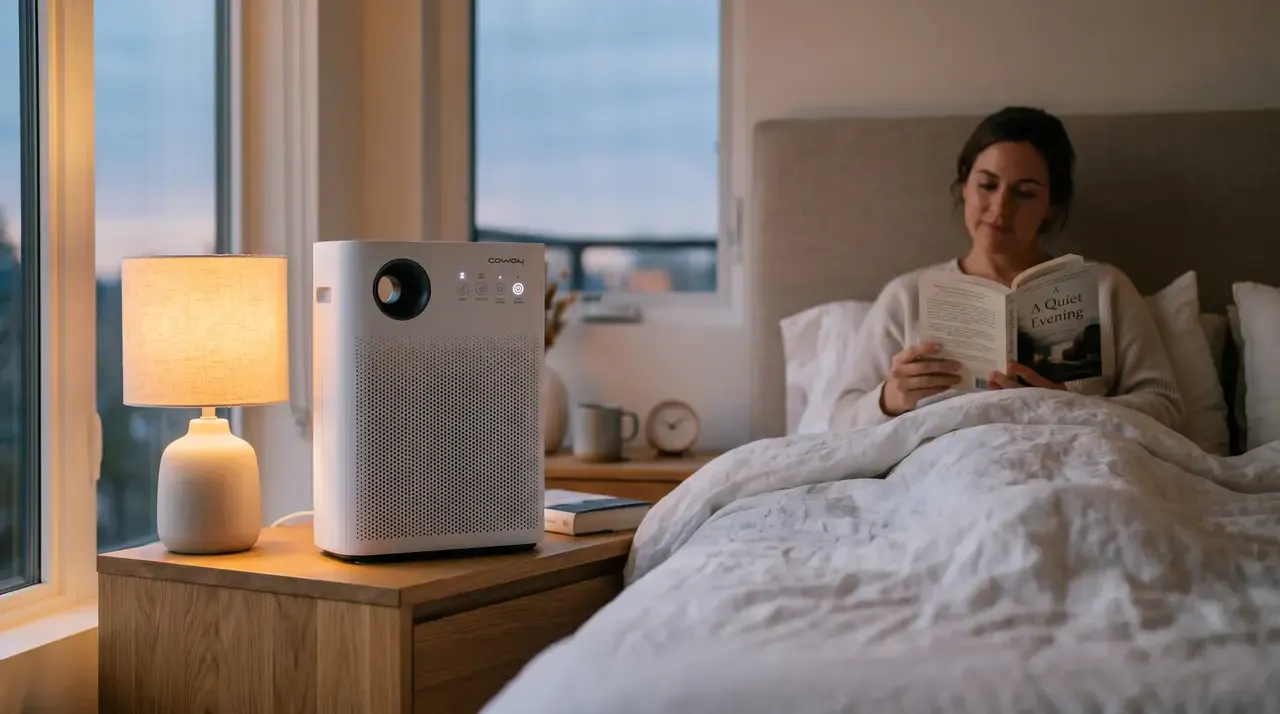
Coway Airmega 200M Review: The HEPA Workhorse for Mid-Sized Rooms
360 sq ft
True HEPA + Activated Carbon
246 / 240 / 233 (Smoke / Dust / Pollen)
24-53 dB
Quick answer
The Coway Airmega 200M is a True HEPA air purifier rated to capture 99.97% of particles down to 0.3 microns, with CADR figures of 246 smoke, 240 dust and 233 pollen. That translates to honest coverage of about 360 sq ft at 4.8 air changes per hour, and noise runs from 24 dB on low to 53 dB on high. It offers an auto mode with an air quality sensor but no app or smart home integration.
Methodology & sources
TestedThis review is backed by a validated long-term test record retained by Claire Fontaine.
Verified on August 8, 2026
Pros
- True HEPA filtration captures 99.97% of particles down to 0.3 microns
- Quiet on low (24 dB), suitable for bedroom use
- Auto mode with reliable air quality sensor
- Filter replacement indicator
Cons
- Coverage maxes out around 360 sq ft, smaller than spec sheet implies
- No app or smart home integration
Best for
- Allergy sufferers
- Bedrooms and home offices up to 360 sq ft
- Budget-conscious buyers wanting True HEPA
Spec comparison
| Spec comparison | Coway Airmega 200M | BLUEAIR Blue Pure 211i Max | BLUEAIR Blue Pure 311i Max |
|---|---|---|---|
| CADR | 246 / 249 / 277 CFM (Smoke / Dust / Pollen) | 435 / 453 / 450 CFM (Smoke / Dust / Pollen, AHAM Verifide) | 283 / 314 / 365 CFM (Smoke / Dust / Pollen, AHAM Verifide) |
| Coverage | 361 sq ft (4.8 ACH); 874 sq ft (2 ACH); 1,748 sq ft (1 ACH) | 674 sq ft (4.8 ACH) | 439 sq ft (4.8 ACH) |
| Noise level | 24.4-55.1 dB(A) | 23-53 dB | 23-50 dB |
| Power | 82 W | 46 W | 32 W |
| Filter type | Pre-filter + deodorization filter + HEPA filter + bipolar device | HEPASilent dual filtration; Particle & Carbon main filter + washable fabric pre-filter | HEPASilent dual filtration; Particle & Carbon main filter + washable fabric pre-filter |
| Filter life | Deodorization filter 6 months; HEPA filter 12 months | 6-9 months (main filter); pre-filter washable | 6-9 months (main filter); pre-filter washable |
| Warranty | 1 year (parts); 3 years (motor and electronic parts) | 1 year limited; 3 years with product registration | 1 year limited; 3 years with product registration |
| Dimensions | 16.8 x 18.3 x 9.6 in (W x H x D) | 22.7 x 14.4 x 14.4 in (H x W x D) | 19 x 12.5 x 12.5 in (H x W x D) |
| Weight | 12.3 lbs | 16.2 lbs | 7.8 lbs |
The market for indoor air purification has exploded over the last few years, transitioning from a niche appliance category to a household necessity. Between increasingly severe allergy seasons, the creeping threat of wildfire smoke, and a heightened general awareness of airborne pathogens, consumers are demanding reliable, effective ways to clean the air inside their homes. But with this surge in demand comes a flood of exaggerated marketing claims, confusing specifications, and overpriced machines that do little more than move air around without actually filtering it.
Filtration: what True HEPA actually means here
The star of the show, however, is the True HEPA filter. The term "HEPA" (High-Efficiency Particulate Air) is heavily regulated, and the Airmega 200M uses a genuine True HEPA filter that captures 99.97% of airborne particles down to 0.3 microns in size.
To put 0.3 microns into perspective: a single strand of human hair is about 70 microns thick. Pollen ranges from 10 to 1000 microns. Pet dander is around 2.5 to 10 microns. Smoke particles and bacteria can be as small as 0.3 microns.
Real-world performance
The Association of Home Appliance Manufacturers (AHAM) independently tests air purifiers and assigns them CADR scores for three specific pollutants. The Airmega 200M boasts impressive numbers: 246 for Smoke, 240 for Dust, and 233 for Pollen.
To determine the maximum room size an air purifier can effectively clean, the industry standard formula is to take the Smoke CADR and multiply it by 1.5. This calculation ensures the unit can clean the air in that room 4.8 times per hour (roughly once every 12 minutes).
- 246 (Smoke CADR) x 1.5 = 369 square feet.
The results were incredibly satisfying. Within 15 minutes, the visible haze was entirely gone. Within 30 minutes, the sharp, acrid smell of the incense was reduced to a faint background note. After an hour, the room smelled completely neutral. This rapid air turnover is exactly what you want when dealing with unexpected pollution, like a kitchen mishap or a sudden influx of wildfire smoke from an open window.
Noise: a closer look
For an appliance designed to be used in bedrooms and home offices, the acoustic profile is just as important as the filtration efficiency. An air purifier that sounds like a jet engine is an air purifier that will inevitably be unplugged and shoved into a closet.
The Coway Airmega 200M operates on three manual fan speeds, plus an Eco/Auto mode. The noise levels range from a whisper-quiet 24 decibels (dB) on the lowest setting to a robust 53 dB on the highest setting.
Let’s break down what those numbers actually sound like in a quiet room.
At 24 decibels on the Low setting, the Airmega 200M is functionally silent. You have to put your ear within a few inches of the top grille to hear the motor running. It is quieter than a typical modern refrigerator and quieter than the ambient noise of a quiet suburban street at night. For bedroom use, this is an absolute dream. It provides just enough of a gentle, smooth sound to let you know it's working, but it will not disturb even the lightest sleepers. This addresses one of the major pros of the unit: it is undeniably suitable for overnight use.
A crucial, often-overlooked aspect of bedroom appliances is light pollution. The Airmega 200M features a large, bright air quality indicator ring on the front. In a dark room, this blue LED is bright enough to cast shadows on the wall. Thankfully, Coway included a dedicated button to turn off the air quality light while leaving the machine running. This shows that Coway actually understands how people use these machines in the real world.
Who should buy it
The Coway Airmega 200M is not a one-size-fits-all solution, but for a specific demographic, it is arguably the best purchase you can make.
Allergy sufferers: If you wake up with a stuffy nose, scratchy throat, or watery eyes, this machine is built for you. The combination of the washable pre-filter and the dense True HEPA filter effectively traps the dust mites, pollen, and pet dander that trigger morning allergy attacks. The 4.8 air changes per hour ensure that the air you are breathing while you sleep is constantly being scrubbed.
Bedrooms and home offices up to 360 sq ft: This is the absolute sweet spot for the Airmega 200M. In rooms of this size, the CADR is perfectly matched to the volume of air. It will keep a primary bedroom impeccably clean, and its quiet noise profile on the low and medium settings makes it an unobtrusive companion while you work from home or sleep.
Lovers of simplicity: If you want an appliance that you plug into the wall, set to Auto, and never think about again until a red light tells you to change the filter, the Airmega 200M is perfect. It is reliable, mechanical, and delightfully straightforward.
Who should skip it
Despite its excellent performance, the Airmega 200M has limitations that make it unsuitable for certain scenarios.
People with open floor plans: If your home features a massive, open-concept living room that flows directly into a kitchen and dining area, the Airmega 200M will simply be outmatched. A 360-square-foot coverage area means it cannot generate the air velocity required to pull pollutants from the far corners of a 700-square-foot great room. For those spaces, you need a much larger unit (like the Coway Airmega 400) or multiple smaller units spread throughout the room.
Those dealing with heavy chemical odors or VOCs: While the carbon sheet is fine for light cooking smells, it does not contain the mass of activated carbon pellets required to adsorb heavy VOCs, fresh paint fumes, or severe, persistent smoke odors. If you live next to a highway or are dealing with serious chemical off-gassing from new furniture, you need a purifier with a dedicated, heavy-duty pelletized carbon filter.
How it compares
Coway Airmega 200M vs. Coway AP-1512HH Mighty This is the most common comparison, and for good reason—they are essentially the exact same machine internally. They share the same motor, the same CADR ratings, the same noise profile, and they even use the exact same replacement filters. The difference is purely aesthetic. The Mighty has a glossy, rounded, iPod-era design, while the 200M features a modern, matte, square grille. Because they are functionally identical, your choice should come down to two things: which design you prefer, and which one is currently on sale. Retailers frequently discount the 200M to slightly lower prices than the Mighty, making it the better value buy.
Coway Airmega 200M vs. Winix 5510 The Winix line is the Airmega's biggest rival, and its current model is the Winix 5510, the app-enabled successor to the long-popular 5500-2. The Winix offers very similar True HEPA performance and a comparable CADR, but it pulls ahead in odor reduction because it uses a washable AOC (Advanced Odor Control) carbon filter built from a granular carbon mesh, rather than a coated fibrous sheet. The Winix also features PlasmaWave technology instead of a standard ionizer, and the 5510 adds the Wi-Fi and true auto mode the old 5500-2 lacked. The downside to the Winix is its physical footprint; it is significantly bulkier and less aesthetically pleasing than the sleek Airmega 200M. If odor control is your absolute top priority, the Winix is slightly better. If you want a balance of aesthetics, compact size, and particulate filtration, the Coway wins.
Verdict
On published specifications, the Coway Airmega 200M is built for exactly one job: moving a large volume of air quietly through True HEPA filtration, with an auto mode that adjusts fan speed to changing room conditions. It does not try to be a design object or a smart-home hub — it is a workhorse on paper, and its long shelf life as a category reference reflects that.
While the lack of smart features might deter tech enthusiasts, and the 360-square-foot realistic coverage limit means it isn't meant for massive open floor plans, these are minor caveats rather than dealbreakers. The Airmega 200M makes up for its lack of Wi-Fi with sheer mechanical reliability, an incredibly sensitive auto mode, and a sleep-friendly noise profile that is hard to beat.
Editorial summary
Coway Airmega 200M review: True HEPA filtration, 246 CFM smoke CADR for an honest 360 sq ft, a 24 dB low speed, and auto mode with no app required.
Where to buy
Check the merchant for the current price and availability. We may earn a commission.