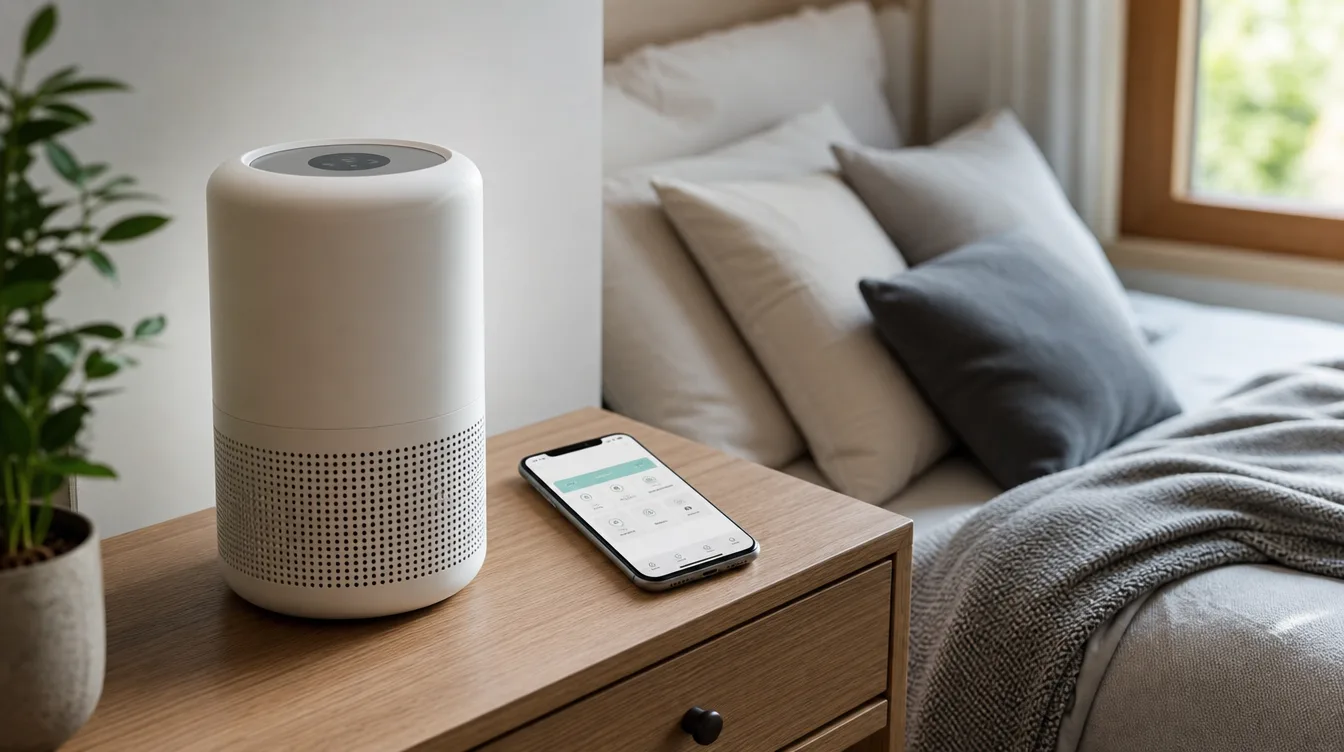
LEVOIT Core 200S-P Review: The Smart Small-Room Step Up From a Desktop Unit?
About 135 sq ft (4.8 ACH)
3-stage nylon pre-filter + HEPA + activated carbon
90 CFM (LEVOIT); 118 CFM (AirPurifierFirst)
24-48 dB (LEVOIT); 42-54 dBA (AirPurifierFirst)
Methodology & sources
TestedThis review is backed by a validated long-term test record retained by Claire Fontaine.
Verified on August 8, 2026
Pros
- App, voice and schedule control in a genuinely compact, inexpensive body
- A real small-room CADR, several times the airflow of a desktop unit
- Purely mechanical three-stage HEPA filtration with no ionizer in the air path
- Very low power draw and a quiet 24 dB sleep-mode rating
Cons
- No onboard air-quality sensor and no true auto mode, only app schedules and timers
- The 672 sq ft coverage claim is a slow single-air-change figure, not real cleaning coverage
- The Core 300S sits only a step up in price yet covers far more room
- Smart setup depends on the VeSync app and a 2.4GHz network
Best for
- A small bedroom, nursery or home office up to roughly 135 to 180 sq ft
- Buyers who want app and voice control without paying for the larger Core 300S
- Anyone stepping up from a desktop unit who wants real small-room airflow on a schedule
Spec comparison
| Spec comparison | LEVOIT Core 200S-P | BLUEAIR Blue Pure 211i Max | BLUEAIR Blue Pure 311i Max |
|---|---|---|---|
| CADR | 90 / 101 / 119 CFM (Smoke / Dust / Pollen, AHAM Verifide) | 435 / 453 / 450 CFM (Smoke / Dust / Pollen, AHAM Verifide) | 283 / 314 / 365 CFM (Smoke / Dust / Pollen, AHAM Verifide) |
| Coverage | 140 sq ft (4.8 ACH); 672 sq ft (1 ACH) | 674 sq ft (4.8 ACH) | 439 sq ft (4.8 ACH) |
| Noise level | 24-48 dB | 23-53 dB | 23-50 dB |
| Power | 37 W | 46 W | 32 W |
| Filter type | 3-stage: nylon pre-filter + main filter + high-efficiency activated carbon | HEPASilent dual filtration; Particle & Carbon main filter + washable fabric pre-filter | HEPASilent dual filtration; Particle & Carbon main filter + washable fabric pre-filter |
| Filter life | 6-8 months | 6-9 months (main filter); pre-filter washable | 6-9 months (main filter); pre-filter washable |
| Warranty | 2-year limited | 1 year limited; 3 years with product registration | 1 year limited; 3 years with product registration |
| Dimensions | 8.1 x 8.1 x 12.6 in | 22.7 x 14.4 x 14.4 in (H x W x D) | 19 x 12.5 x 12.5 in (H x W x D) |
| Weight | 6.6 lbs | 16.2 lbs | 7.8 lbs |
If you want app and voice control in a genuinely small room but do not want to pay for the larger Core 300S, the LEVOIT Core 200S-P is the model that fills that gap. It is the smart step between two units already covered here: it adds a real fan and a real small-room clean-air rate over the plug-in-and-forget LEVOIT Core Mini-P, and it undercuts the LEVOIT Core 300S on size and price while keeping the Wi-Fi, VeSync app and voice control that make a purifier easy to use. For a small bedroom, nursery or home office, sized honestly, it is a tidy, connected little machine.
Who should skip it? Anyone shopping for the 672 square feet printed on the listing, and anyone who wants the purifier to sense the air and adjust itself. The Core 200S-P is smart in the sense that a phone can drive it, not in the sense that it watches the room — no air-quality sensor, no true auto mode. Match it to a small room and use its schedules and it earns its place; ask it to cover a living room or to run itself off a sensor, and a different unit is the smarter buy.
Where it sits in the LEVOIT ladder
LEVOIT's small purifiers read as three rungs of a ladder. At the bottom is the Core Mini-P, a near-silent desktop cleaner with roughly 46 CFM of airflow and an honest coverage near 61 square feet — a personal-space appliance, not a room unit. At the top of the compact tier is the Core 300S, a true small-room machine with a 141 CFM smoke CADR, a real 219 square feet of coverage and schedule-driven automation.
The Core 200S-P slots between them, and the letter is the clue: the "S" marks it as the connected version of the plain Core 200. It carries a rated CADR of 90 CFM — roughly double the airflow of the Mini and a genuine small-room figure — in a compact body at 6.6 pounds. What you gain over the Mini is real room airflow plus Wi-Fi and voice control; what you give up against the 300S is coverage, a True HEPA drum filter and, most importantly, its scheduling-driven auto behavior. That middle position is the whole decision here.
What "smart" means here, and what it does not
The reason to pick the Core 200S-P over a cheaper manual unit is the control layer. It pairs to the VeSync app over a 2.4GHz Wi-Fi network, works with Amazon Alexa and Google Assistant, and takes 2, 4 or 8 hour timers or fuller custom schedules. For a bedroom or nursery, being able to drop it to sleep mode by voice, or ramp it up on a schedule before allergy season, is the everyday value.
It is worth being precise about the ceiling on that intelligence, because it is the Core 200S-P's defining limitation. There is no onboard air-quality sensor, and, as the specialist reviewer AirPurifierFirst notes, no true auto mode — the unit cannot read the room and adjust itself the way a sensor-equipped purifier does. Everything smart about it is push-based: a phone, a voice command or a preset schedule. That is a step below even the Core 300S, whose automation leans on connected scheduling to change speeds for you. Buy the 200S-P for app and voice convenience, not for a machine that senses smoke and reacts on its own.
CADR and the honest room-size math
Here is where the box needs translating. LEVOIT gives the Core 200S-P an AHAM Verifide Clean Air Delivery Rate of 90 CFM — a modest number, exactly right for a small unit and nowhere near the coverage the listing implies.
Apply the coverage rule this site uses for every purifier: multiply the clean-air delivery by 1.5 to find the area the unit can clean at a meaningful 4.8 air changes per hour.
- 90 CFM x 1.5 = about 135 square feet at 4.8 air changes per hour.
That lands almost exactly on LEVOIT's own 4.8-air-changes figure of 140 square feet, which is the honest working size: a small bedroom, a nursery, a compact office. AirPurifierFirst lists a slightly higher combined figure near 118 CFM, which would stretch the honest coverage toward 180 square feet — so call the realistic ceiling somewhere around 135 to 180 square feet depending on which figure you trust.
The 672 square feet on the listing is the same machine measured at a single air change per hour — a slow maintenance cadence for holding already-clean air, not for knocking down an active pollen or smoke problem. Treat 672 square feet as a theoretical ceiling and roughly 135 to 180 square feet as the room where the Core 200S-P does its best work. (New to these numbers? The how to choose an air purifier guide walks through CADR, ACH and coverage.)
What "quiet enough" costs you in coverage
A CADR figure is measured at a purifier's loud top speed, and clean-air delivery falls as the fan slows. Run the Core 200S-P on the quiet lower speeds you would actually tolerate overnight and its already-modest airflow drops further — one more reason to keep it in a genuinely small room, where even a reduced clean-air rate still turns the air over often enough to matter. Point it at a large lounge and the same small fan cannot keep up, quiet or loud.
Filtration: three stages and the True HEPA question
The Core 200S-P runs a three-stage filter: a nylon pre-filter for hair and coarse dust, a HEPA-grade main filter for fine particulate, and a high-efficiency activated-carbon layer for light odors. LEVOIT markets the particle stage as HEPA; AirPurifierFirst describes it as a True HEPA element. The label wording matters less than the practical result, which is a competent mechanical filter for pollen, fine dust, mold spores and dander in the small volume of air the unit moves — and, importantly, no ionizer in the air path. If the True HEPA labeling question interests you, the HEPA vs True HEPA guide explains why the wording varies between brands.
The carbon layer is a coated stage rather than a deep granular bed, so treat it as an everyday-freshness tool for cooking smells and light odors rather than a heavy-duty scrubber. For serious, constant odor, a purifier built around a pellet-carbon bed like the LEVOIT Vital 200S-P holds up far longer.
Running cost, kept qualitative
The Core 200S-P is cheap to live with day to day: it barely touches the power bill, drawing only about 37 watts at full speed and far less on its lower settings. The recurring expense is the combined three-stage filter, replaced as a single part on roughly a six-to-twelve-month cycle — sooner in a home with pets or heavy cooking, since the carbon and pre-filter load faster than the HEPA media wears out. The app's filter-life indicator prompts you well before airflow suffers, so the ongoing cost is predictable.
Noise and design
For a small unit the Core 200S-P is honest about noise. LEVOIT rates a sleep-mode floor as low as 24 decibels — quiet enough to disappear beside a bed — rising to about 48 decibels at full speed. AirPurifierFirst recorded a higher real-world floor nearer 42 dBA climbing to roughly 54 dBA flat out, so expect the quietest, most pleasant setting to also move the least air. The sensible approach is to let a schedule keep it low overnight and only surge it when the room needs a quick clean-down.
The design is the other small-room advantage. At 6.6 pounds and a compact cylinder footprint, the Core 200S-P is easy to move between rooms, with a tidy look and a display that dims for sleep — a genuinely small appliance that happens to carry a phone-and-voice control layer, which is exactly its appeal.
The third-party consensus
Because this site does not run a lab, the honest way to judge a purifier is to aggregate the independent reviewers who do. On the Core 200S-P the useful source is AirPurifierFirst, whose figures appear throughout this review: the roughly 118 CFM airflow, the 42-to-54 dBA noise range and — most usefully — the flat statement that the unit lacks a true auto mode and an air-quality sensor. Their verdict is a capable, stylish small-room purifier that is easy to use and easy on the wallet, best kept to a bedroom or small office rather than pushed into a larger space — which matches the coverage math above.
Who should buy it
Small-room buyers who want smart control are the target. In a bedroom, nursery or office of 135 to 180 square feet, the Core 200S-P delivers real small-room airflow plus the app, voice and schedule control that make a purifier easy to run properly instead of leaving it on one speed forever.
Anyone stepping up from a desktop unit gets several times the airflow of a Core Mini-P while keeping a compact body — the right move when a personal-space cleaner is no longer enough for the whole small room.
Who should skip it
Anyone with a real living room or open plan should look elsewhere. The 90 CFM CADR cannot clean the space the 672-square-foot claim implies; a larger unit such as the LEVOIT Core 400S or Core 600S is the right call.
Buyers who want a sensor and auto mode get none here — the Core 200S-P leaves the reacting to you. For automation that reads the room, step up to the LEVOIT Core 300S with its scheduling-driven auto behavior, or to the Vital 200S-P, which adds a genuine onboard air-quality sensor and closed-loop auto mode.
How it compares
Against the Core Mini-P, the 200S-P is the more serious machine — roughly double the airflow, real small-room coverage and full app-and-voice control — at the cost of a slightly larger body. Against the Core 300S, the two are natural neighbors, and the 300S is the one to stretch for if the budget allows: it covers 219 square feet to the 200S-P's 135, carries a True HEPA drum filter and adds scheduling-driven automation, all for a modest step up. And against the similarly small Shark HP102, the LEVOIT counters with cheaper running and full smart control while the Shark answers with a genuine PM1/PM2.5/PM10 sensor the 200S-P lacks entirely. For a fuller shortlist, see the best air purifiers guide.
Verdict
The LEVOIT Core 200S-P is a well-judged middle rung: more capable than a desktop unit, cheaper and smaller than the Core 300S, and genuinely easy to run thanks to its app, voice and schedule control. Its 90 CFM CADR translates to an honest 135 square feet or so — not the 672 on the listing — and its defining limit is that it is smart without being sensing: no air-quality sensor, no true auto mode, just push-based control. Buy it for a small bedroom, nursery or office where a phone and a schedule are all the automation you need, ignore the coverage math on the box, and it is a likable, connected little purifier. Want it to cover a real room, or to watch the air and react on its own, and the small step up to the Core 300S is the smarter spend.
Editorial summary
A full review of the LEVOIT Core 200S-P, the smart small-room step between the Core Mini-P and the Core 300S, covering its 90 CFM CADR, app and voice control, three-stage HEPA filtration and the honest coverage a compact unit really delivers.
Where to buy
Check the merchant for the current price and availability. We may earn a commission.