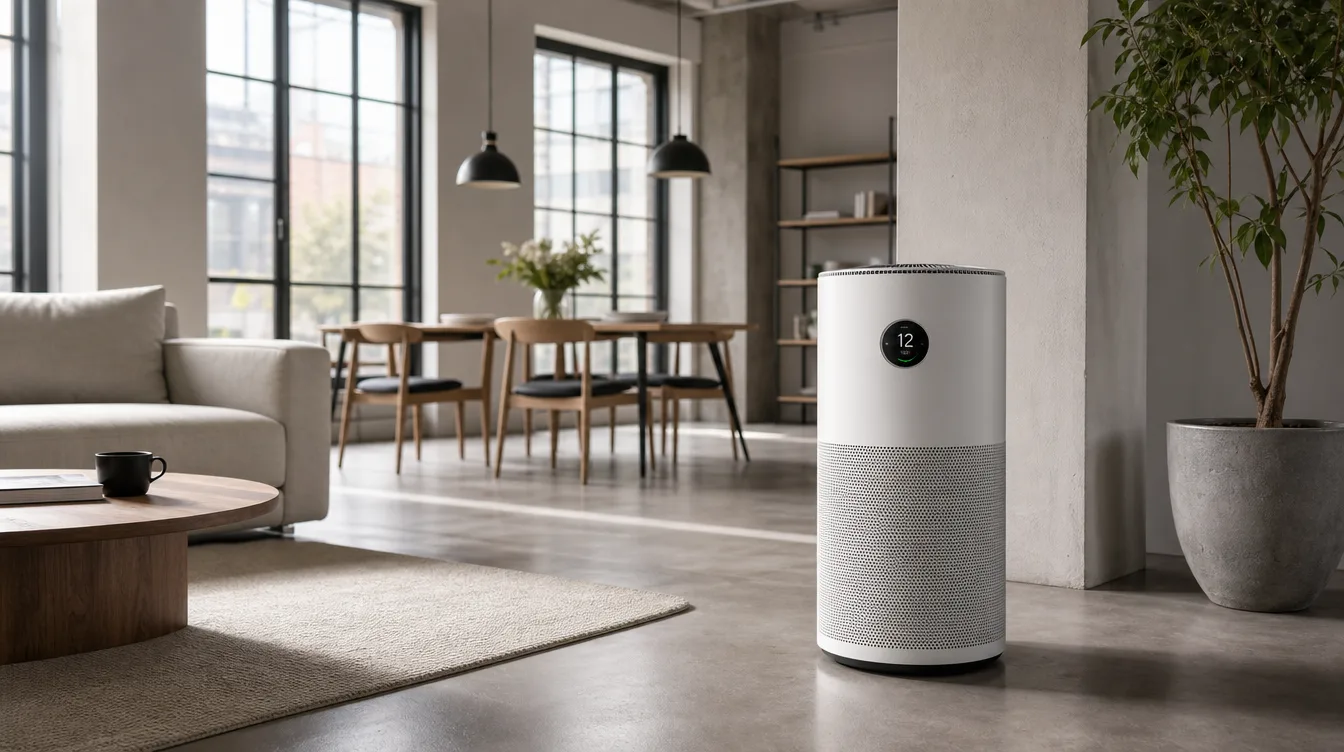
LEVOIT Core 600S Review: Big Air Delivery for Open-Plan Rooms
606 sq ft (4.8 ACH)
3-stage HEPA + high-efficiency activated carbon
391 / 398 / 436 CFM (Smoke / Dust / Pollen)
26-55 dB
Methodology & sources
TestedThis review is backed by a validated long-term test record retained by Claire Fontaine.
Verified on August 8, 2026
Pros
- 391 CFM smoke CADR clears a genuine open-plan room fast
- VortexAir airflow and a laser PM2.5 sensor driving a real auto mode
- Covers roughly 606 sq ft at a meaningful 4.8 air changes per hour
- Efficient 49 W draw and an Energy Star listing for a big unit
Cons
- A tall appliance near two feet high that needs real floor space
- The bonded 3-stage filter is replaced as a single ongoing consumable
- On its top speed the fan reaches an audible 55 dB
Best for
- Open-plan living areas and great rooms up to about 606 sq ft
- Buyers who have outgrown a Core 400S or a mid-size purifier
- Homes wanting a laser PM2.5 display and true auto mode in a large unit
Spec comparison
| Spec comparison | LEVOIT Core 600S | BLUEAIR Blue Pure 211i Max | BLUEAIR Blue Pure 311i Max |
|---|---|---|---|
| CADR | 391 / 398 / 436 CFM (Smoke / Dust / Pollen, AHAM Verifide) | 435 / 453 / 450 CFM (Smoke / Dust / Pollen, AHAM Verifide) | 283 / 314 / 365 CFM (Smoke / Dust / Pollen, AHAM Verifide) |
| Coverage | 606 sq ft (4.8 ACH); 2,909 sq ft (1 ACH) | 674 sq ft (4.8 ACH) | 439 sq ft (4.8 ACH) |
| Noise level | 26-55 dB | 23-53 dB | 23-50 dB |
| Power | 49 W | 46 W | 32 W |
| Filter type | 3-stage: pre-filter + main filter + custom high-efficiency activated carbon | HEPASilent dual filtration; Particle & Carbon main filter + washable fabric pre-filter | HEPASilent dual filtration; Particle & Carbon main filter + washable fabric pre-filter |
| Filter life | 6-12 months | 6-9 months (main filter); pre-filter washable | 6-9 months (main filter); pre-filter washable |
| Warranty | 2-year limited | 1 year limited; 3 years with product registration | 1 year limited; 3 years with product registration |
| Dimensions | 12.3 x 12.3 x 23.6 in | 22.7 x 14.4 x 14.4 in (H x W x D) | 19 x 12.5 x 12.5 in (H x W x D) |
| Weight | 13.7 lbs | 16.2 lbs | 7.8 lbs |
When a purifier has to clean a whole open-plan floor rather than a single room, most of the popular models quietly run out of air. The LEVOIT Core 600S is the machine you buy when that happens. It is the largest-capacity unit in LEVOIT's mainstream smart line, built for great rooms, combined kitchen-and-lounge spaces and open floor plans where a mid-size purifier would clean the air near itself and leave the far end stale. It pairs one of the highest clean-air outputs in its price class with a laser PM2.5 sensor and a numeric display, and it does so at a running cost that stays surprisingly modest for such a big machine.
Who should skip it? Anyone whose problem is a normal bedroom or a mid-size living room — for those, the smaller Core 300S or Core 400S delivers the same filtration idea in a body that costs less to buy and takes up less space. The Core 600S only justifies itself when the room is genuinely large.
Positioning: the top of the ladder
Read LEVOIT's smart range as a ladder of room sizes. The Core 300S covers a bedroom up to about 219 square feet; the Core 400S steps up to a living room near 347 square feet and adds a laser sensor. The Core 600S sits a decisive rung above both, built for the open-plan spaces the 400S starts to strain in.
The jump is not incremental. The 600S delivers a smoke CADR of 391 CFM against the 400S's 231 — roughly seventy percent more clean air per minute — and grows a taller body to house a much larger filter and LEVOIT's VortexAir airflow path. If your problem is a living room, the 400S is the smarter spend. If your problem is an open floor plan or a genuinely large great room, the 600S is the entry point, and the smaller models will simply be outmatched.
The 3-stage filter and VortexAir airflow
The Core 600S is built around a tall cylindrical three-stage filter. The outermost layer is a pre-filter for coarse debris — pet hair, lint and visible dust. Behind it sits the HEPA main filter that captures the fine particulate responsible for most indoor misery: pollen, mold spores, fine dust, dander and a large share of smoke particulate. The innermost layer is a bed of custom high-efficiency activated carbon for odors and light volatile organic compounds — cooking smells, pet odor and off-gassing that a particle filter alone cannot address.
What lets the 600S move so much air through that dense media is LEVOIT's VortexAir design, which draws air in low and around the filter and exhausts it upward in a spiral, keeping a large room circulating through the machine rather than pooling in dead corners. The three-in-one filter is convenient — one part, one swap — with the usual trade-off that when any single layer is spent, the whole assembly is replaced together.
A useful way to picture it: the pleats inside that tall cylinder unfold into far more square footage of surface area than the unit's footprint suggests. That surface area is what lets the 600S pull a big volume of air through dense media without choking airflow, which is the whole trick of a large-room purifier.
CADR and the honest room-size math
Here is where a large purifier proves itself, and where the marketing needs translating. The Core 600S carries AHAM Verifide Clean Air Delivery Rates of 391 CFM for smoke, 398 CFM for dust and 436 CFM for pollen. Those independently verified figures are what actually predict performance.
Apply the coverage rule this site uses for every unit: multiply the smoke CADR by 1.5 to find the square footage the machine can clean at a meaningful 4.8 air changes per hour.
- 391 CFM x 1.5 = about 587 square feet at 4.8 air changes per hour.
LEVOIT's own 4.8-ACH figure lands at 606 square feet, essentially the same answer, and that is the honest working size to shop by. At that coverage the full volume of a 600-square-foot room passes through the filter roughly every twelve or thirteen minutes — fast enough to keep pollen, dust and smoke suppressed across an open plan rather than merely stirred around near the unit.
The box, meanwhile, advertises coverage up to nearly 2,900 square feet. That headline is the same machine measured at a single air change per hour — a slow cadence suited to maintaining already-clean air, not to knocking down an active problem. Treat the 2,900-square-foot number as the theoretical ceiling and roughly 606 square feet as the room size where the 600S does its best work. Between the two is a comfortable zone: a 750-square-foot open plan will still be well served on a higher fan speed, just at fewer air changes than a tighter room would enjoy.
The laser PM2.5 sensor and auto mode
The feature that most clearly separates the 600S from smaller LEVOIT units is its laser dust sensor. Rather than the color-changing indicator on cheaper purifiers, the 600S draws a sample of air across a laser and reports an actual PM2.5 reading as a number on the front display.
That number changes how the machine feels to live with. When someone starts cooking, the figure climbs and you can watch it fall again as the purifier clears the room; a color ring shifts from blue through amber to red as a quick visual cue. For anyone managing asthma or a specific sensitivity, seeing the pollutant level respond in near real time is far more reassuring than a vague good-or-bad light.
Crucially, that sensor drives a genuine auto mode. Set the unit to auto and it raises or lowers fan speed on its own to chase the PM2.5 reading back down, then eases off once the air is clean. In a large, busy room where air quality swings through the day — morning activity, an evening of cooking, a pet stirring — that closed-loop behavior is the single best reason to own the 600S rather than run a fixed speed and hope.
Placement in a big room
A large purifier only delivers its rated coverage if the air can actually reach it, and in an open plan that is not guaranteed. The 600S wants breathing space; tucking it hard against a wall, behind a sofa or into a tight alcove chokes the intake and drops real-world performance well below the spec sheet no matter how high the CADR reads.
In an open floor plan the ideal spot is reasonably central, or at least well clear of the walls, with a clear path between the unit and the parts of the room where people actually sit and cook. Corners are the enemy of even coverage: a purifier stuck in one cleans the air near itself and leaves a slow dead zone diagonally opposite. If the space is long or L-shaped, position the 600S toward the busier half — the kitchen end, or wherever dander and everyday dust are generated — rather than the geometric center.
Noise, size and running cost
A large purifier moving a large volume of air cannot be silent, and the 600S is honest about it. LEVOIT rates it from a sleep-mode floor near 26 decibels up to about 55 decibels at full tilt. That top speed is clearly audible, closer to a running dishwasher than a whisper, though the character is a smooth rush rather than a grating whine, and auto mode spends most of its time on the lower, quieter speeds.
The bigger consideration is physical presence. Standing near two feet tall on a roughly foot-square footprint, this is a piece of furniture, not an accessory — it needs real floor space and looks like the serious appliance it is. On the ledger's better side, it is efficient: rated at just 49 watts with an Energy Star listing, it has one of the best clean-air-per-watt ratios in its class, so running it continuously has a modest effect on the power bill. The ongoing expense to plan for is the three-in-one filter, on roughly a six-to-twelve-month cycle depending on load; vacuum the pre-filter every few weeks and let auto mode do its job to stretch that interval, and the app's filter-life counter will prompt you before airflow suffers.
The third-party consensus
Because this site does not run a lab, the honest way to gauge a large purifier is to aggregate the independent testers who do. On the Core 600S they line up behind the same conclusion: it is the value champion of the large-room category. HouseFresh frames it as one of the best-value options for cleaning a big room, precisely because it delivers a high CADR at a price well below the premium large-room benchmarks. That is the reputation to buy into — not that the 600S out-specs a premium flagship, but that it delivers most of the same real-world clearing at a fraction of the cost.
Who should buy it
Households with a genuinely large space to clean are the target buyer — an open-plan kitchen-and-lounge, a great room, a large primary suite up to roughly 606 square feet. These are exactly the rooms where the 600S's CADR and auto mode shine and where a mid-size purifier falls short.
Data-minded owners and allergy or asthma sufferers get the most from the laser sensor. If you want to see your PM2.5 level as a number and watch the machine respond across a big room, this is the LEVOIT to buy.
Value-focused large-room shoppers who balk at premium prices get most of the flagship experience for markedly less.
Who should skip it
Small and mid-size bedroom buyers are the clearest skip. In a room under about 350 square feet the 600S is more machine than the space needs; the Core 400S or the compact Core 300S fits better and costs less to run.
Anyone tight on floor space should measure first. This is a tall, wide tower, and in a cluttered room it can feel imposing.
How it compares
Against its own sibling the Core 400S, the story is simplest: the 600S delivers markedly more clean air and covers a much larger room, at the cost of a bigger footprint and a higher price, while sharing the same laser sensor and auto mode. Choosing between them is really a matter of measuring your room before you shop — inside 350 square feet the 400S is the right spend, beyond it the 600S is. Against premium large-room rivals from Coway and Blueair, the 600S trades a little polish and brand cachet for a decisively lower price and a very similar real-world clearing rate, which is exactly why independent testers keep pointing value-focused large-room buyers toward it.
Verdict
The Core 600S is LEVOIT scaling its proven formula up to the open plan without abandoning the value that made its small units famous. The 391 CFM smoke CADR translates to an honest 606 square feet of real coverage, the laser PM2.5 sensor with its numeric readout turns air quality into something you can watch and trust, and the 49-watt draw keeps a big machine cheap to run. The compromises are exactly what you would expect from a large appliance: it takes up real space, it is audible when it works hard, and its all-in-one filter is a recurring cost. Accept those, point it at a room large enough to justify it, and the Core 600S is one of the most capable large-room purifiers you can buy without stepping into genuinely premium territory.
Editorial summary
A full review of the LEVOIT Core 600S large-room air purifier, covering its 391 CFM smoke CADR, VortexAir airflow, laser PM2.5 sensor and AHAM Verifide coverage.
Where to buy
Check the merchant for the current price and availability. We may earn a commission.