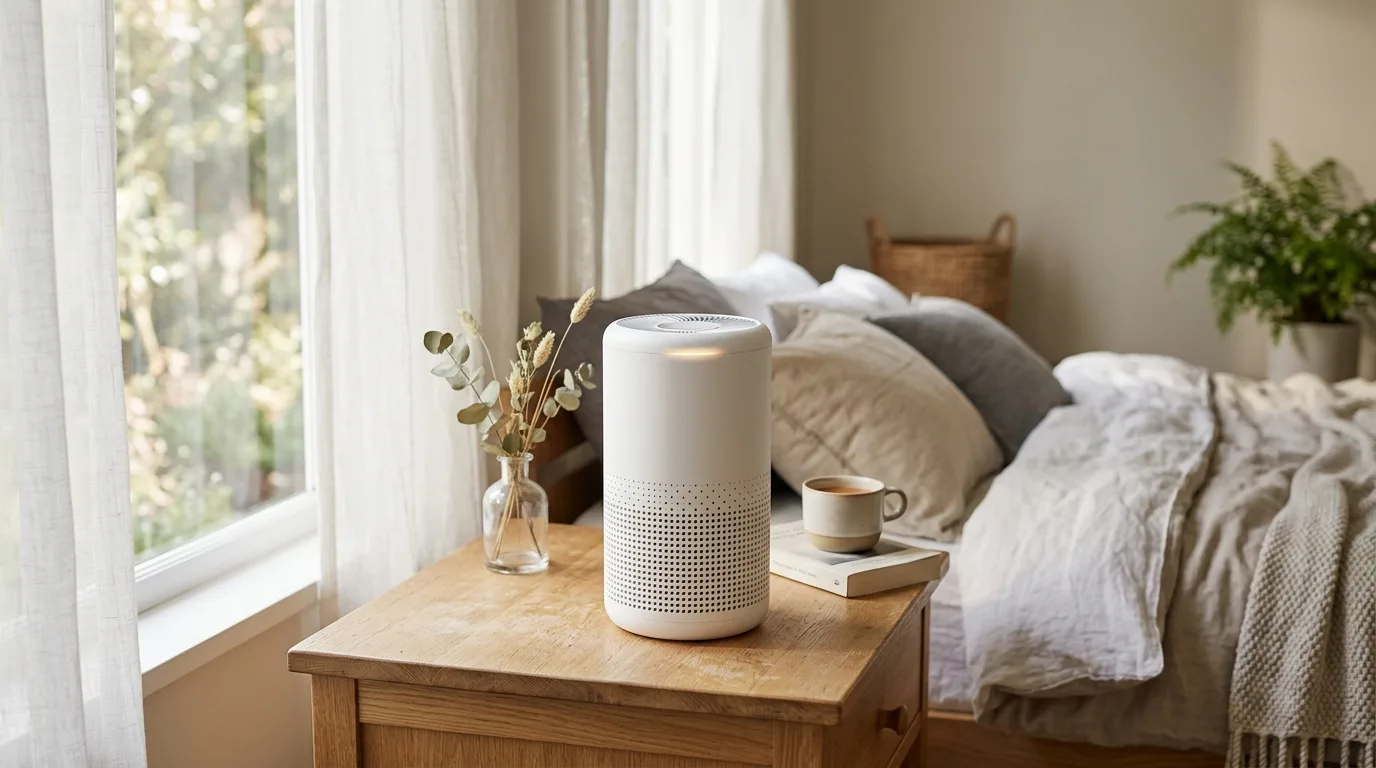
Winix A231 Review: Core 300 Speed With a Sensor on Top
230 sq ft (AHAM Verifide)
360-degree pre-filter + True HEPA + carbon + PlasmaWave
147 / 149 / 154 (Smoke / Dust / Pollen)
25 dB minimum
Methodology & sources
TestedThis review is backed by a validated long-term test record retained by Claire Fontaine.
Verified on August 8, 2026
Pros
- AHAM-verified CADR that outruns the Levoit Core 300 class
- Real air quality sensor and auto mode in the budget tier
- Genuine replacement filters cost less than equivalent Levoit filters
- Compact, light and whisper-quiet on its lowest speed
Cons
- No Wi-Fi, app or voice control of any kind
- Thin carbon layer is not built for heavy odor or VOC loads
- No settings memory, so a power cut restores factory defaults
- Runs out of steam in rooms much beyond its 230 sq ft rating
Best for
- Small bedrooms, dorms and home offices up to about 230 sq ft
- Buyers who want a sensor and auto mode without leaving the budget tier
- Allergy and pet households in small rooms watching long-term filter costs
Spec comparison
| Spec comparison | Winix A231 | BLUEAIR Blue Pure 211i Max | BLUEAIR Blue Pure 311i Max |
|---|---|---|---|
| CADR | 147 / 149 / 154 CFM (Smoke / Dust / Pollen) | 435 / 453 / 450 CFM (Smoke / Dust / Pollen, AHAM Verifide) | 283 / 314 / 365 CFM (Smoke / Dust / Pollen, AHAM Verifide) |
| Coverage | 230 sq ft (AHAM Verifide); up to 1,104 sq ft in 1 hour | 674 sq ft (4.8 ACH) | 439 sq ft (4.8 ACH) |
| Noise level | 25 dB minimum | 23-53 dB | 23-50 dB |
| Power | 55 W | 46 W | 32 W |
| Filter type | 4-stage 360-degree: fine mesh pre-filter + True HEPA + activated carbon + PlasmaWave | HEPASilent dual filtration; Particle & Carbon main filter + washable fabric pre-filter | HEPASilent dual filtration; Particle & Carbon main filter + washable fabric pre-filter |
| Filter life | True HEPA 12 months; activated carbon 12 months | 6-9 months (main filter); pre-filter washable | 6-9 months (main filter); pre-filter washable |
| Warranty | 2 years | 1 year limited; 3 years with product registration | 1 year limited; 3 years with product registration |
| Dimensions | 9.5 x 9.5 x 14.6 in (W x D x H) | 22.7 x 14.4 x 14.4 in (H x W x D) | 19 x 12.5 x 12.5 in (H x W x D) |
| Weight | 6.75 lbs | 16.2 lbs | 7.8 lbs |
| Origin | Thailand | — | — |
The Winix A231 is what happens when a company known for big, serious purifiers shrinks the formula without dumbing it down. It is a compact 360-degree machine built on the same four-stage filtration philosophy as its towering siblings, with an AHAM-verified 230 square feet of coverage and — the part that matters most at this end of the market — an onboard air quality sensor driving a true auto mode. Independent measurements back the pitch: HouseFresh, which buys its units at retail and measures them in its own lab, clocked the A231 clearing its lab room faster than the Levoit Core 300 and made it a top small-purifier pick.
That combination is rarer than it sounds. The budget compact class is dominated by purifiers that either skip the sensor entirely or hide auto mode behind a pricier smart variant. The A231 offers sensor-driven automation at the same tier as the sensor-free incumbents, backed by AHAM Verifide CADR figures rather than marketing promises.
A smaller Winix, built the Winix way
Winix made its reputation on mid-size towers like the 5500-2 and its app-enabled successor, the Winix 5510, and the A231 is recognizably the same philosophy in a smaller jacket. At 9.5 by 9.5 by 14.6 inches and 6.75 pounds, it is a genuinely compact appliance — nightstand-friendly and easy to carry between rooms.
What matters more is what Winix kept: AHAM Verifide certification at 230 square feet, so the clean air delivery rates come from independent verification rather than a brochure; a four-stage filter path; an optional PlasmaWave stage; and a sensor-led auto mode. What it leaves out is just as deliberate — no Wi-Fi, no app, and the deep washable carbon bed of the bigger Winix machines replaced by a slimmer all-in-one cartridge.
360 degrees of four-stage filtration
Instead of pulling air through a flat front panel, the A231 draws it in from every direction through a single cylindrical cartridge — the Filter O — and exhausts upward. Inside are four distinct stages.
Stage one is a fine-mesh pre-filter that catches hair, lint and large dust. Unlike the washable pre-filter on the larger Winix towers, this one is integrated into the cartridge and replaced along with it.
Stage two is a True HEPA filter rated to capture 99.97% of airborne particles down to 0.3 microns — the standard defense against pollen, dust, mold spores, dander and fine smoke particulate.
Stage three is an activated carbon layer for odors and volatile organic compounds. Honesty is required here: the carbon in a compact cartridge is a thin, impregnated sheet rather than the deep granular bed found in the 5510, and HouseFresh's teardown notes describe it the same way — adequate for light cooking and pet smells, but not the tool for a serious smoke or VOC problem.
Stage four is PlasmaWave, Winix's bipolar ionization technology, which can be switched off entirely. More on that below.
The distinction that matters for shoppers: True HEPA captures particles, while carbon and PlasmaWave address gases and odors. The A231 is genuinely strong on the first and merely adequate on the second, which is exactly what a small-room purifier should be.
A word on PlasmaWave
Bipolar ionization can produce trace ozone, and some buyers prefer to avoid the technology on principle. On the A231 it is a toggle: switch it off and a capable three-stage mechanical purifier remains. One quirk worth knowing, surfaced by HouseFresh's time with the unit: the A231 has no settings memory, so a power loss restores factory defaults with PlasmaWave back on. If you prefer it off, check after any outage.
CADR and coverage, done honestly
The A231's AHAM-verified Clean Air Delivery Rates are 147 CFM for smoke, 149 CFM for dust and 154 CFM for pollen — a well-balanced set, and notably strong for the class. Run the smoke figure through the site's coverage rule, smoke CADR multiplied by 1.5, to find the room it can clean at a meaningful 4.8 air changes per hour:
- 147 CFM x 1.5 = about 220 square feet at 4.8 air changes per hour.
That lines up almost perfectly with the official AHAM Verifide rating of 230 square feet at roughly five air changes per hour, and with HouseFresh's own 222-square-foot recommendation — three independent routes to the same answer. The box also advertises cleaning rooms up to 1,104 square feet in one hour — a real number, but a single, slow air change better suited to holding clean air than to scrubbing an active pollution event. Shop by the 230-square-foot figure.
What HouseFresh's lab found
The most useful third-party data comes from HouseFresh, which measured the A231 in its 728-cubic-foot lab room. At top speed with PlasmaWave enabled, the A231 removed all traces of PM1 pollution in 40 minutes; without PlasmaWave it needed 46. In HouseFresh's comparison table, the Levoit Core 300S took 45 minutes on the same exercise, and HouseFresh's headline finding has the A231 fourteen minutes ahead of the Levoit Core 300 — a striking result for a purifier in the same budget tier.
HouseFresh's sound and power measurements fill out the picture: 35.2 decibels on the lowest speed, 48.3 on medium and 57.9 on high, plus a modest 45.6 watts at full tilt, and a measured top-speed PM1 CADR of 148 CFM that matches the official smoke figure almost exactly. HouseFresh's conclusion mirrors the data — for buyers who genuinely need a small purifier, this one sits at the top of its list, with the caveat that anyone who can fit a larger machine should still oversize.
Noise: the honest range
Winix quotes a 25-decibel minimum noise level, achieved in the manual sleep mode — whisper territory, comfortably bedside. HouseFresh's per-speed measurements show the rest of the range: quiet on low, a steady fan presence on medium, firmly audible on high. Small-purifier physics still apply — running slowly moves little air, so near the top of its rating expect real time on the louder speeds when pollution spikes — but auto mode keeps the unit low whenever the air is clean, so the loud end stays the exception.
Auto mode without the app
The A231's headline feature in this price class is its single smart sensor. It watches the room, drives a three-color LED air quality indicator — blue for good, amber for fair, red for poor — and powers a true auto mode that raises the fan when air quality dips and settles it back down afterward. A manual sleep mode drops the unit to its quietest setting for the night.
What there is not: Wi-Fi, an app, phone-based scheduling or voice assistants — the spec sheet lists smart features as none. That is the honest trade of the budget tier, and the alternative is worth naming plainly: Levoit bundles the same sensor-plus-auto package only with the pricier, app-enabled Core 300S. The A231 gives you the automation and keeps the controls on the unit.
Design and living with it
The A231 is one of the better-looking small purifiers: a clean white-and-grey flared body with a touch panel on top and the air quality light ringed around it. The 360-degree intake pulls from every direction, so a few inches of clearance all around is all it asks, though the sensor at the back should stay unblocked. The filter cartridge twists out from the base, and HouseFresh notes a welcome detail: the base resists accidental unlocking far better than the Core 300's, so moving the unit never dumps the filter on the floor. A filter change indicator tells you when the yearly swap is due.
Running cost, kept qualitative
The A231 is inexpensive to keep. Winix rates the True HEPA and carbon stages inside the Filter O cartridge for roughly twelve months, and genuine Winix replacements cost less than the equivalent Levoit filters — HouseFresh flags them as some of the best-value genuine filters going, with generic cartridges lowering the yearly outlay further. Energy draw is equally gentle: the unit is ENERGY STAR certified, and HouseFresh measured a modest wattage even at full speed, so running it around the clock stays cheap. ETL certification and a two-year warranty, with Winix promising to fix or replace a qualifying unit, round out the ownership picture.
Who should buy the A231
Small-bedroom and home-office buyers get the full package: verified coverage up to about 230 square feet, a sensor that runs the machine for you, and sleep-mode quiet.
Value-focused shoppers get sensor-driven auto mode without stepping up to a smart-model premium, plus some of the cheapest genuine filters in the class.
Allergy and pet households in small rooms get a True HEPA workhorse whose CADR numbers are verified rather than asserted.
Who should skip it
Large-room buyers need more machine; beyond roughly 230 square feet the A231 runs out of steam.
App and smart-home users should look to connected rivals; there is no remote control of any kind here.
Households fighting heavy smoke, odor or VOCs need a deeper carbon bed than a compact cartridge can hold — the 5510 class is the right tool for that job.
How it compares
The natural rival is the Levoit Core 300, the long-standing default in this size class. In HouseFresh's room-clearing measurements the A231 is the faster machine, and it adds the air quality sensor and auto mode the Core 300 lacks entirely. The Core 300's counter is a huge third-party filter ecosystem; on automation and measured speed, the Winix wins.
The Levoit Core 300S is the fairer fight: it matches the sensor and auto mode and adds app and voice control, but that connectivity is exactly what you pay extra for. If remote control matters, the 300S earns its premium; if the purifier will live on auto in one room, the A231 delivers the core experience for less outlay.
Against the Winix 5510, this is not a competition but a division of labor. The 5510 covers roughly 380 square feet with a deep washable carbon bed built for smoke and odor; the A231 is the small-room specialist. Many homes would sensibly run one of each.
Verdict
The Winix A231 is the rare budget compact that asks for almost no compromises. Its AHAM-verified CADR translates to an honest 220 to 230 square feet of real coverage, its four-stage 360-degree cartridge delivers proper True HEPA particle capture, and its onboard sensor and auto mode bring set-and-forget automation to a tier where rivals still charge extra for it. HouseFresh's lab measurements confirm what the spec sheet promises.
It asks you to accept a small room as your ceiling, a carbon layer built for light rather than heavy odor duty, and life without an app. Do that, and the A231 is the easiest small-purifier recommendation going: verified, automated and inexpensive to run. For a bedroom, dorm or office up to about 230 square feet, this is the compact to beat.
Editorial summary
Editorial overview of the Winix A231 based on published manufacturer specifications and third-party lab measurements, covering its 360-degree 4-stage True HEPA filtration, AHAM-verified 230 sq ft coverage and sensor-driven auto mode.
Where to buy
Check the merchant for the current price and availability. We may earn a commission.