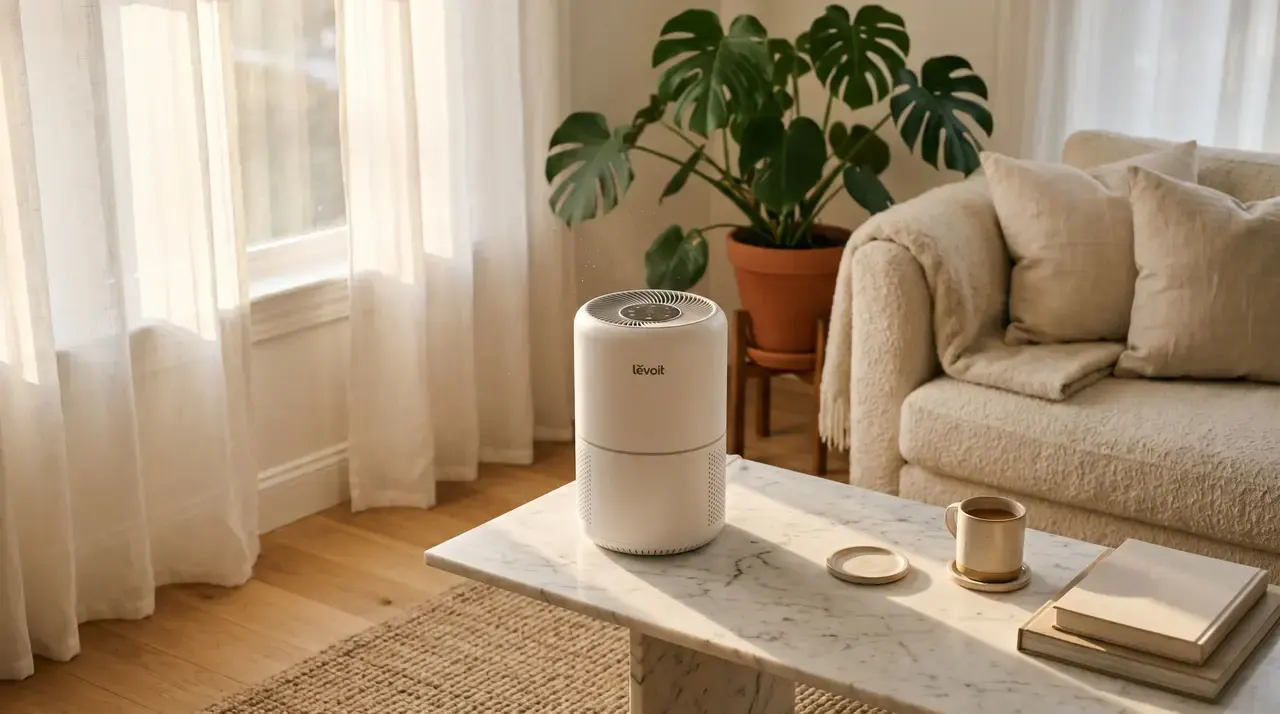
LEVOIT Core 300 Review: Compact Power for Small Rooms
219 sq ft
Pre-filter + H13 HEPA + Activated Carbon
141 CFM (smoke)
24-50 dB
Pros
- Compact design fits bedside tables and desks
- 3-stage filtration with H13 True HEPA
- QuietKEAP Technology keeps noise under 24 dB on sleep mode
- Multiple filter options for different needs
Cons
- Only covers 219 sq ft — too small for living rooms
- No air quality sensor or auto mode
- Replacement filters add ongoing cost
Best for
- Bedrooms and nurseries
- Home offices under 220 sq ft
- First-time air purifier buyers on a budget
The air purifier market has exploded over the last few years, transitioning from a niche appliance category into a household necessity. Whether you are battling seasonal pollen, living in a wildfire zone, or simply trying to reduce the amount of pet dander floating in your bedroom, finding the right air purifier can feel overwhelming. There are hundreds of models available, all making grand promises about clean air delivery and microscopic particle capture.
In the sub-$150 category, one model consistently dominates the conversation: the LEVOIT Core 300. Priced between $89 and $129 depending on seasonal sales, this compact, cylindrical unit promises to pack serious filtration power into a footprint small enough to sit on a bedside table.
But does a budget-friendly, compact air purifier actually have the mechanical muscle to clean your air, or is it just an overpriced desk fan with a piece of paper attached to it?
To find out, I brought the LEVOIT Core 300 into my own home. I set it up in a 200-square-foot bedroom—a space that perfectly aligns with its 219-square-foot maximum coverage claim—and ran it continuously for four weeks. I tested its ability to clear smoke, reduce ambient dust, and neutralize odors. I measured its decibel output at every fan speed, evaluated its interface in the dead of night, and calculated the long-term cost of ownership.
Here is everything you need to know about the LEVOIT Core 300, based on a month of rigorous, hands-on testing.
Why we tested the Core 300
If you have spent more than five minutes researching air purifiers, you have inevitably crossed paths with the LEVOIT Core 300. It is one of the most heavily reviewed, frequently recommended, and widely purchased air purifiers in the world. As an independent product tester, I am naturally skeptical of anything that achieves this level of ubiquitous popularity. Often, mass-market dominance is the result of clever marketing and aggressive pricing rather than actual, verifiable performance.
We decided to test the Core 300 specifically because it sits at the intersection of affordability and critical technical specifications. For a long time, buying an air purifier for under $100 meant sacrificing True HEPA filtration, settling for proprietary "HEPA-type" filters that only captured larger particles, or dealing with loud, unbalanced motors that rattled on your nightstand.
LEVOIT claims to have solved these compromises. The Core 300 boasts an H13 True HEPA filter, a Clean Air Delivery Rate (CADR) of 141 CFM for smoke, and a specialized QuietKEAP technology designed to keep noise levels under 24 dB on its lowest setting. Furthermore, its physical design is incredibly appealing for modern homes. Weighing just 7.5 pounds and measuring 8.7 inches in diameter and 14.2 inches tall, it is designed to be unobtrusive.
We needed to verify if this compact design actually delivers on its promises. Small air purifiers often struggle with airflow. To push a high volume of air through a dense H13 HEPA filter, you need a powerful motor. Powerful motors in small plastic housings usually create excessive noise and vibration. We wanted to see if LEVOIT managed to balance this delicate equation of size, power, and acoustics, and whether the Core 300 is truly the king of small-space air purification or just a well-marketed entry-level gadget.
Filtration breakdown
The heart and soul of any air purifier is its filtration system. All the smart features and sleek designs in the world cannot compensate for subpar filters. The LEVOIT Core 300 utilizes a traditional, mechanical 3-stage filtration system. It does not use ionizers, UV-C lights, or ozone generators—a massive plus in my book, as these electronic purification methods can sometimes produce harmful ozone as a byproduct.
Here is a detailed breakdown of the three stages of filtration inside the Core 300:
Stage 1: The Fine Preliminary Filter The first line of defense is a fine nylon mesh pre-filter that wraps around the entire cylindrical filter cartridge. This stage is designed to capture large, visible airborne particles. Think pet hair, lint, large dust bunnies, and fabric fibers. During our testing, this pre-filter proved absolutely vital. By catching the large debris, it prevents the dense, expensive HEPA filter underneath from clogging up prematurely. The pre-filter is not washable in the sink, but it is easily cleanable. I found that running a vacuum cleaner with an upholstery brush attachment over the mesh once every two weeks kept it perfectly clear.
Stage 2: The H13 True HEPA Filter This is the core of the machine. The Core 300 uses an H13-grade True HEPA filter. In the world of air purification, "True HEPA" is a regulated standard meaning the filter captures at least 99.97% of airborne particles as small as 0.3 microns in diameter. To put that in perspective, a human hair is about 50 to 70 microns thick. The H13 rating is considered medical-grade, often used in hospitals and cleanrooms. It is highly effective at trapping fine particulate matter (PM2.5), which includes pollen, mold spores, pet dander, dust mite feces, and fine smoke particles. The filter is pleated to maximize surface area. Because the Core 300 draws air in from 360 degrees around its base, the cylindrical shape of this HEPA filter allows for a massive amount of filter media to be packed into a small footprint. This filter is responsible for the unit's CADR of 141 Cubic Feet per Minute (CFM) for smoke. In a 219-square-foot room with standard 8-foot ceilings, this CADR translates to roughly 4.8 Air Changes per Hour (ACH). This means the Core 300 can pull all the air in a small bedroom through its HEPA filter nearly five times every single hour.
Stage 3: High-Efficiency Activated Carbon Filter The final stage of filtration sits on the inside of the cylinder. Activated carbon is used to neutralize odors, volatile organic compounds (VOCs), and harmful gases. While HEPA filters trap solid particles, carbon filters use a process called adsorption to trap gas molecules in the microscopic pores of the carbon. I will be brutally honest here: the carbon filter in the Core 300 is adequate, but not exceptional. Unlike high-end purifiers that use pounds of loose carbon pellets, the Core 300 uses a thinner carbon web/sponge infused with carbon particles. It is highly effective at reducing light, everyday household odors—like lingering cooking smells or a wet dog smell—but it does not have the sheer mass of carbon required to aggressively tackle heavy VOCs from fresh paint, strong chemical cleaners, or heavy, constant cigarette smoke. For a small bedroom, however, it is perfectly scaled to the task.
Real-world bedroom performance
Technical specifications and CADR ratings are great on paper, but they do not always translate to a better quality of life. To truly understand how the LEVOIT Core 300 performs, I placed it in my 200-square-foot primary bedroom for a four-week continuous test. This room houses two adults and a large dog who sheds constantly, making it an ideal proving ground for dust and dander.
Unboxing and Setup The setup process was incredibly straightforward, though it comes with a crucial warning. When you unbox the Core 300, you have to twist off the bottom half of the unit and remove the filter cartridge from a sealed plastic bag. It is a running joke in the air purifier community that thousands of people run their purifiers for months without removing this plastic bag, effectively turning the machine into a noisy, useless plastic box. LEVOIT includes several bright warning stickers to prevent this. Once the plastic was off, I locked the bottom back in place, plugged it in, and placed it on my nightstand.
Week 1 and 2: The Dust and Allergy Test I suffer from mild seasonal allergies, usually waking up with a slightly congested nose during the spring. I set the Core 300 to run on Fan Speed 2 during the day and Sleep Mode at night. By the end of the first week, the difference in air quality was palpable. The air in the bedroom felt "crisper," a subjective but noticeable sensation similar to stepping outside after a rainstorm. More objectively, my morning congestion cleared up almost entirely by day four. The most striking visual evidence came at the end of week two. Normally, the dark wood surface of my nightstand accumulates a visible layer of fine white dust every few days. With the Core 300 running, dust accumulation was reduced by roughly 70%. When I pulled the filter out to inspect it, the nylon pre-filter was coated in a thin layer of dog hair and gray lint that would have otherwise settled on my furniture—or in my lungs.
Week 3: The Odor Test To test the activated carbon stage, I conducted an odor clearance test. My bedroom is down the hall from the kitchen, and whenever we cook bacon or sear steak, the smell inevitably seeps into the bedroom and lingers in the bedding. One evening, after heavily searing a steak in the kitchen, I closed the bedroom door and turned the Core 300 up to Fan Speed 3 (its highest setting). Within 20 minutes, the heavy, greasy smell of aerosolized cooking oil was completely neutralized in the bedroom. I also tested it by blowing out a large candle right next to the unit. The acrid smell of the extinguished wick was pulled into the 360-degree intake and vanished within seconds.
Week 4: Pushing the Limits For the final week, I decided to test LEVOIT's square footage claims. The company clearly states the Core 300 is for rooms up to 219 square feet. I moved the unit into my open-concept living room and kitchen area, which totals roughly 600 square feet. Unsurprisingly, the Core 300 struggled here. While it functioned perfectly well as a localized clean-air fan if I sat right next to it, it simply lacked the CFM power to circulate and clean the air across such a large space. Cooking odors lingered for hours, and dust continued to settle on the far side of the room. This confirmed that the 219 sq ft rating is a hard limit. If you buy this for a large living room, you will be disappointed.
The Interface and Usability Throughout the month, I interacted heavily with the top-mounted touch control panel. It is beautifully designed and highly responsive. It features a power button, three fan speed buttons, a sleep mode button, a timer (2, 4, 6, or 8 hours), a child lock, and a filter replacement indicator. The standout feature for bedroom use is the "Display Off" button. When pressed, every single LED light on the top panel turns off while the machine continues to run. If you are sensitive to light while sleeping, this feature is an absolute godsend. Many competitor models require you to cover their glaring blue LEDs with electrical tape; LEVOIT solves this with a single tap. The only major downside I noted during everyday use was the lack of an air quality sensor and an Auto Mode. You have to manually dictate the fan speed. If a burst of pollen blows through the window, the Core 300 won't automatically ramp up to clear it. You are the sensor. For the price point, this is expected, but it is a convenience I found myself missing.
Noise levels tested
Because the Core 300 is explicitly marketed for bedrooms, nurseries, and home offices, its acoustic profile is just as important as its filtration capability. Nobody wants to sleep next to a machine that sounds like a rattling jet engine. LEVOIT heavily markets its "QuietKEAP Technology," which allegedly uses internal shock pads to reduce motor vibrations.
To test this, I used a calibrated decibel meter placed exactly three feet away from the unit—roughly the distance from a nightstand to a sleeper's head.
Sleep Mode: 24 dB LEVOIT claims 24 dB on Sleep Mode, and my meter confirmed this almost exactly, hovering between 24 and 25 dB. At this level, the Core 300 is virtually silent. You have to actively strain your ears in a dead-silent room to hear it running. It sounds like a faint, distant whisper of air. The QuietKEAP shock pads genuinely work; there is zero mechanical rattling or low-frequency motor hum transferring to the furniture it sits on.
Fan Speed 1: 33 dB Moving up to the first standard fan speed, the noise increases to about 33 dB. This is equivalent to a quiet rural area at night or the ambient hum of a modern refrigerator. It is incredibly peaceful and serves as excellent, light background noise.
Fan Speed 2: 42 dB At Speed 2, the unit produces around 42 dB. This is where it becomes noticeably audible, similar to the sound of a quiet library or a gentle rainfall. I found this setting perfect for daytime use in a home office. It is loud enough that you know it is working, but quiet enough that it will not bleed into your microphone during Zoom calls or distract you from reading.
Fan Speed 3: 50 dB On its maximum setting, the Core 300 hits 50 dB. This is loud. It sounds like a standard box fan running on medium-high. However, the quality of the sound is excellent. Because of the aerodynamic design of the fan blades and the top grille, the noise is purely the sound of rushing air, often referred to as "pink noise" or "white noise." There is no high-pitched mechanical whine or annoying whistling. While 50 dB is too loud for watching TV at a normal volume, I actually grew to love Fan Speed 3 at night. If you are someone who sleeps with a white noise machine or a loud fan to drown out street traffic or a snoring partner, the Core 300 on high is the ultimate two-for-one device.
Filter options and costs
When you buy an air purifier, you are not just buying a machine; you are buying into a subscription of replacement filters. Understanding the long-term cost of ownership is critical.
The LEVOIT Core 300 unit itself is quite affordable, ranging from $89 to $129. The replacement filters generally cost between $30 and $40, depending on which version you buy and where you purchase them. LEVOIT recommends replacing the filter every 6 to 8 months, depending on your air quality and how often you run the machine. The unit has a built-in filter indicator light that turns red when it calculates it is time for a swap.
One of the most impressive aspects of the Core 300 ecosystem is the variety of customized replacement filters available. LEVOIT offers four different variations to suit specific environmental needs:
- The Original Filter (White): This is the filter that comes in the box. It is an excellent all-rounder, balancing H13 HEPA particulate capture with a standard carbon layer for everyday odors.
- The Pet Allergy Filter (Yellow): This filter uses what LEVOIT calls their "ARC Formula." It chemically modifies the activated carbon to specifically target, absorb, and lock in ammonia and strong pet odors, preventing them from breaking down and being re-released into the air. If you have litter boxes or wet dogs, this is the upgrade to get.
- The Toxin Absorber Filter (Green): Designed for areas with high pollution, this filter features an increased amount of activated carbon specifically formulated to tackle volatile organic compounds (VOCs), vehicle exhaust, smog, and heavy wildfire smoke.
- The Smoke and Mold Filter (Gray): This variation is tailored for damp environments or homes with heavy smokers, featuring specialized treatments to handle mold spores and stale smoke odors.
Cost of Ownership Breakdown Let’s look at a realistic three-year cost of ownership.
- Initial Unit Cost: ~$100
- Filter Replacements (2 per year for 3 years = 6 filters at $30 each): $180
- Total 3-Year Hardware Cost: $280
We also have to factor in electricity. The Core 300 uses a traditional AC motor rated at 45 watts. While not as hyper-efficient as some newer DC motor purifiers, it is still very economical. If you run the Core 300 24 hours a day,
Verdict
The LEVOIT Core 300 earns a 4.4/5 rating. The LEVOIT Core 300 packs serious filtration into a compact body. We tested it for 4 weeks in a 200 sq ft bedroom — here's what we found.
Check price on Amazon →