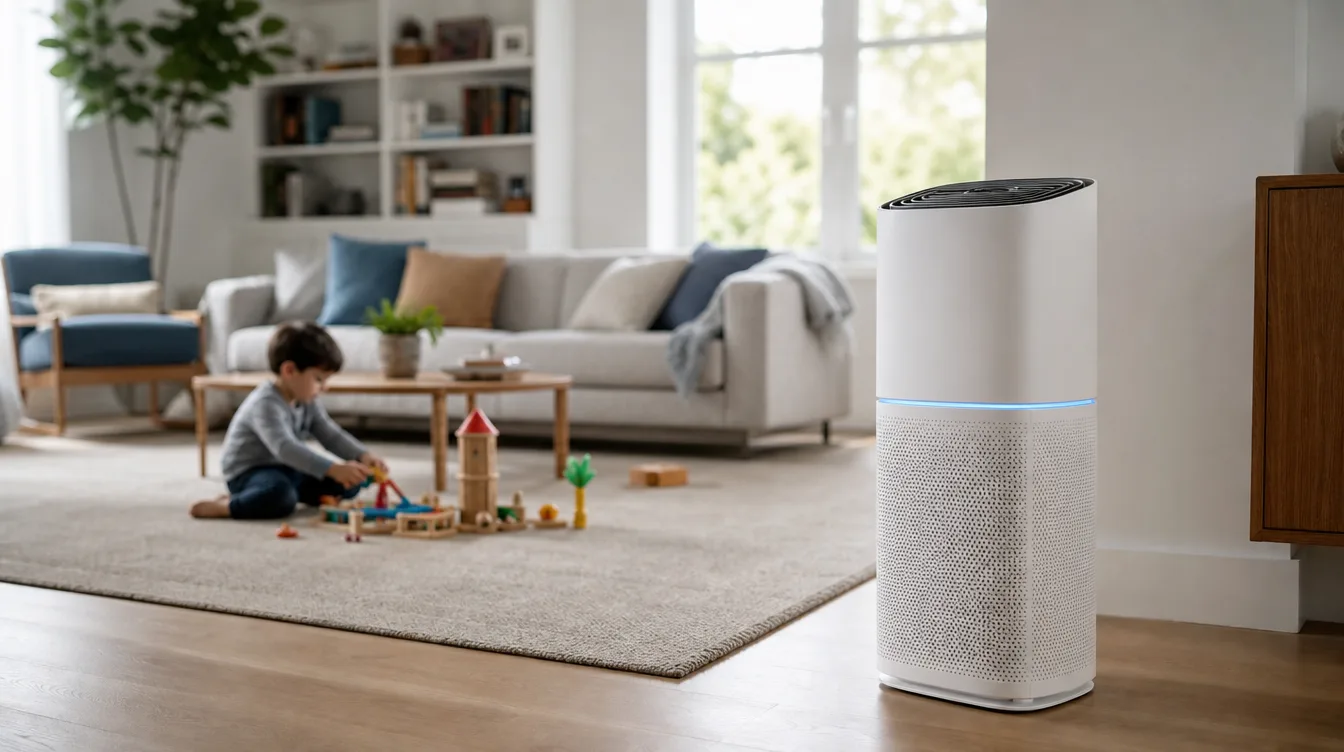
Shark HP152 NeverChange Review: What the 5-Year Filter Claim Really Means
About 145 sq ft (4.8 ACH); 650 sq ft at 1 ACH
4-stage washable pre-filter + pet layer + NanoSeal HEPA + odor cartridge
97 CFM
40-62 dBA (AirPurifierFirst); 32-49 dB (TechGearLab)
Methodology & sources
TestedThis review is backed by a validated long-term test record retained by Claire Fontaine.
Verified on August 8, 2026
Pros
- A genuinely washable pre-filter and a HEPA rated to last years rather than months
- Very low power draw, around 26 watts even at full speed
- Big-brand NanoSeal HEPA capturing fine particulate down to 0.1 microns
- Purely mechanical filtration with no ionizer in the air path
Cons
- The 650 sq ft coverage claim is badly overstated for real allergy-grade cleaning
- The "never change" HEPA still needs a separate odor cartridge every three to six months
- Independent reviewers doubt the HEPA lasts a full five years under heavy or all-day use
- On its top speed the fan is clearly audible, past 60 dBA by one measurement
Best for
- A small-to-mid room up to roughly 145 to 160 sq ft, sized to the real CADR rather than the box
- Buyers drawn to a 5-year HEPA who understand the odor cartridge is still a consumable
- Anyone who wants a washable pre-filter and very low power draw in a big-brand unit
Spec comparison
| Spec comparison | Shark HP152 NeverChange | BLUEAIR Blue Pure 211i Max | BLUEAIR Blue Pure 311i Max |
|---|---|---|---|
| CADR | 97 / 105 / 114 CFM (Smoke / Dust / Pollen, ENERGY STAR) | 435 / 453 / 450 CFM (Smoke / Dust / Pollen, AHAM Verifide) | 283 / 314 / 365 CFM (Smoke / Dust / Pollen, AHAM Verifide) |
| Coverage | 150 sq ft (ENERGY STAR); purifies up to 650 sq ft in 1 hour | 674 sq ft (4.8 ACH) | 439 sq ft (4.8 ACH) |
| Power | 26 W | 46 W | 32 W |
| Filter type | True HEPA multi-filter: NanoSeal HEPA + Odor Neutralizer cartridge + Debris Defense rinseable screens | HEPASilent dual filtration; Particle & Carbon main filter + washable fabric pre-filter | HEPASilent dual filtration; Particle & Carbon main filter + washable fabric pre-filter |
| Filter life | Up to 5 years (NeverChange HEPA) | 6-9 months (main filter); pre-filter washable | 6-9 months (main filter); pre-filter washable |
| Warranty | 2-year limited | 1 year limited; 3 years with product registration | 1 year limited; 3 years with product registration |
| Dimensions | 9.76 x 9.53 x 15.16 in (L x W x H) | 22.7 x 14.4 x 14.4 in (H x W x D) | 19 x 12.5 x 12.5 in (H x W x D) |
| Weight | 9.74 lbs | 16.2 lbs | 7.8 lbs |
| Noise level | — | 23-53 dB | 23-50 dB |
The Shark HP152 NeverChange is built around one of the most attractive promises in the category — a HEPA filter rated to last five years instead of the usual six-to-twelve-month swap — and the honest way to judge it is to take that promise apart. The good news is real: the main NanoSeal HEPA genuinely is designed to run for years, backed by a washable pre-filter that keeps it from clogging, and the unit sips power. The catch is equally real: "NeverChange" describes the HEPA only, and the odor half of the machine is a separate cartridge you still replace two to four times a year. Understand that split and the HP152 is a fair small-room purifier; take "never change" at face value and it will not save what the marketing implies.
Who should skip it? Anyone shopping for the 650 square feet printed on the box — a serious overstatement of what a 97 CFM unit can keep genuinely clean — and anyone who reads "NeverChange" as zero ongoing filter cost. Size it to the room it can actually clean and budget for the odor cartridge, and the Shark makes sense; expect it to cover a great room and never cost anything more in filters, and it disappoints on both counts.
What the 5-year claim actually covers
The hook is doing real work in a category where the sticker price is only ever half the story and the filter subscription is the rest, so it deserves taking apart. The answer is a qualified yes with an asterisk large enough to change the decision: two things make the HP152's long life possible, and one thing quietly undercuts it.
The five-year rating applies to the NanoSeal HEPA filter, and it is enabled by the stage in front of it: a washable "Debris Defense" pre-filter that catches hair, lint and coarse dust before they reach the HEPA media. Keeping that load off the expensive filter is exactly what lets it survive years rather than months, the same physics that makes a washable pre-filter valuable on any purifier.
The number itself comes with conditions worth reading. Shark's five-year figure is tested to the GB/T18801-2015 standard, and it is defined at the point where the filter's clean-air delivery has fallen by 50 percent, under a regimen of a 300-square-foot room, 12 hours a day, on the maximum fan speed. Two implications follow. First, "lasts five years" means "has not lost more than half its clean-air rate" by then — a generous end-of-life definition rather than a promise of like-new performance throughout. Second, that lifespan assumes a specific, fairly light duty cycle; run the unit around the clock, or in a dustier or smokier home, and it ages faster. Independent reviewers are openly skeptical of the full five years in real conditions: AirPurifierFirst expects a small HEPA like this to need replacing every one to two years in practice, noting the media resembles the yearly-replacement filters in Shark's HP100 series. Treat five years as a best-case ceiling, not a guarantee.
The odor cartridge is the catch
Here is the part the name glosses over, and it is the single most important thing to know before buying. The HP152 handles odor with a separate Odor Neutralizer cartridge — an activated-carbon element, roughly 90 grams of carbon — that is not covered by the five-year claim. Carbon saturates on its own schedule regardless of how the HEPA is doing, and independent reviewers put its replacement cadence at every three to six months. TechGearLab flags exactly this, noting the odor cartridge "requires more frequent replacements" and that it "undercuts the 'NeverChange' promise a bit."
So the honest running-cost picture is not "no filters ever." It is: rinse the washable pre-filter, keep the HEPA for a few years, and buy an odor cartridge two to four times a year. For a home with real odor to manage — cooking, pets, smoke — that cartridge is not optional, and it is the recurring expense the marketing quietly leaves out. The HP152 lowers filter cost meaningfully compared with a purifier that replaces a combined filter every year; it does not eliminate it.
CADR and the honest room-size math
The filter story aside, the HP152 has the same coverage problem as its smaller sibling. Shark rates it with a Clean Air Delivery Rate of 97 CFM — a modest figure, appropriate for a small unit, and nowhere near the 650-square-foot machine the box advertises.
Apply the coverage rule this site uses for every purifier: multiply the CADR by 1.5 to find the area the unit can clean at a meaningful 4.8 air changes per hour.
- 97 CFM x 1.5 = about 145 square feet at 4.8 air changes per hour.
That is the honest working size: a bedroom, a small office, a nursery. Shark's own 4.8-air-changes figure lands near 150 square feet, essentially the same answer. The 650 square feet on the packaging is the same machine measured at a single air change per hour — a slow cadence for holding already-clean air rather than knocking down an active problem. Treat 650 square feet as a theoretical ceiling and roughly 145 to 160 square feet as the room where the HP152 does its best work. This is the identical overclaim the Shark HP102 carries — rated 500 square feet, honest nearer 120 — so it is a pattern to expect from the brand rather than a one-off. (New to these numbers? The how to choose an air purifier guide walks through CADR, ACH and coverage.)
What "quiet enough" costs you in coverage
A CADR figure is measured at a unit's loud top speed, and clean-air delivery falls as the fan slows. Run the HP152 on the quieter speeds you would tolerate overnight and its already-modest 97 CFM drops further — one more reason to keep it in a genuinely small room. Independent reviewers report strong particle reduction in rooms around 150 square feet and progressively slower results as the room grows past what the fan can honestly serve.
Filtration: NanoSeal HEPA and the washable pre-filter
The HP152 runs a four-stage stack: the washable Debris Defense pre-filter, a pet-particle layer aimed at dander, the Odor Neutralizer carbon cartridge, and Shark's NanoSeal HEPA as the main particle stage. Shark rates the HEPA to capture 99.98% of particles down to 0.1 microns, the same NanoSeal media used in the HP102, and tested to the IEST standard rather than the classic 0.3-micron True HEPA benchmark. In practice that is a strong particle filter; the different reference size is worth understanding rather than fearing, and the HEPA vs True HEPA guide explains why the label wording varies between brands.
The washable pre-filter is the genuinely useful design choice here, and it echoes how the LEVOIT Vital 200S-P uses the same idea: a rinsable coarse stage that takes the load off the media behind it and never appears on a shopping list. On the Vital it protects a bonded HEPA-and-carbon part; on the HP152 it protects a five-year HEPA while the carbon lives in its own replaceable cartridge — the difference being where the carbon sits and how often it turns over.
Running cost, kept qualitative
Two things govern what the HP152 costs to live with, and they pull in opposite directions. In its favor: it is remarkably frugal on electricity, drawing only about 26 watts even at full speed, and the washable pre-filter plus multi-year HEPA remove the biggest recurring filter expense that sinks cheaper purifiers. Against it: the odor cartridge is a real, ongoing consumable on a three-to-six-month cycle, so a household that needs odor control should budget for it rather than assume "NeverChange" means nothing to buy. The net is a purifier cheaper to run than most over several years — provided you plan for the cartridge and do not run it so hard that the HEPA ages early.
Noise and design
Measurements of the HP152's noise vary by source, which is worth flagging honestly. AirPurifierFirst recorded a range from about 40 dBA on the lowest speed up to 62 dBA flat out — that top figure is clearly audible, closer to a raised voice than a whisper — while TechGearLab measured a lower band, roughly 32 to 49 dB. Either way the pattern is familiar: the quietest setting is fine for a bedroom, and the top speed is best reserved for a quick clean-down rather than overnight running. The sensible approach is to keep it on a low speed and only surge when the air needs it.
The design is a compact tower at about 7.25 pounds, easy to move and unobtrusive in a corner, with a plain, brand-forward look and simple onboard controls plus a timer. There is no air-quality sensor driving an automatic mode here, so everything runs from the physical controls — simpler than an app-driven purifier, but with no phone control or auto response for anyone who wants it.
The third-party consensus
Because this site does not run a lab, the honest way to judge a purifier is to aggregate the independent reviewers who do. On the HP152 the threads are consistent. AirPurifierFirst and TechGearLab both praise the low power draw, the washable pre-filter and the strong particle capture, and both push back on the marketing: AirPurifierFirst doubts the HEPA reaches a full five years under real use, and TechGearLab singles out the odor cartridge's three-to-six-month replacement as undercutting the "never change" promise. The shared verdict is a competent, frugal small-to-mid-room purifier whose headline claims — five-year filter and 650-square-foot coverage — both need translating before you buy.
Who should buy it
Small-room buyers who value low upkeep are the target. In a bedroom or office of 145 to 160 square feet, the HP152's washable pre-filter, multi-year HEPA and roughly 26-watt draw add up to a genuinely low-maintenance, low-running-cost unit — as long as the odor cartridge is part of the plan.
Big-brand and washable-pre-filter shoppers get a recognizable name, a purely mechanical air path with no ionizer, and a rinsable coarse stage that keeps the expensive filter alive far longer than a disposable-only design.
Who should skip it
Anyone with a real living room or open plan should look elsewhere. The 97 CFM CADR cannot clean the space the 650-square-foot claim implies; a genuine large-room unit such as the LEVOIT Core 600S or the Blueair Blue Pure 211i Max is the right call.
Buyers who read "NeverChange" as zero filter cost should reset that expectation before buying. The odor cartridge is a recurring purchase; if a truly hands-off running cost matters more than a big brand, the washable-pre-filter LEVOIT Vital 200S-P is the more transparent value.
How it compares
Against the Shark HP102, the two share the same overclaimed-coverage DNA but split on features: the HP102 counters with a genuine PM1/PM2.5/PM10 sensor and auto mode the HP152 lacks, while the HP152 answers with the washable pre-filter and multi-year HEPA the HP102 does not have. Choose the HP102 for sensing, the HP152 for lower long-run filter cost. Against the LEVOIT Vital 200S-P, the Vital covers a much larger honest room on a 250 CFM CADR and adds a real air-quality sensor and auto mode — a more capable machine for a bigger room, at a higher price and with a yearly filter rather than a five-year one. For a fuller shortlist, see the best air purifiers guide.
Verdict
The Shark HP152 NeverChange is an honest deal wearing a slightly dishonest name. The five-year HEPA is real and genuinely useful, the washable pre-filter that makes it possible is the right design, and at roughly 26 watts the unit costs almost nothing to run. But "NeverChange" covers the HEPA alone: the odor cartridge is a separate consumable replaced every three to six months, independent reviewers doubt the HEPA truly reaches five years under all-day use, and the 97 CFM CADR translates to an honest 145 square feet, not the advertised 650. Buy it for a small-to-mid room, budget for the odor cartridge, and it is a frugal, low-maintenance purifier that lives up to the sensible half of its pitch. Buy it expecting a large room cleaned for free forever, and the marketing has written a check the hardware was never going to cash.
Editorial summary
A full review of the Shark HP152 NeverChange, examining what the 5-year filter claim really covers, the separate odor cartridge it still needs, its 97 CFM CADR and the honest small-room coverage behind a 650 sq ft box claim.
Where to buy
Check the merchant for the current price and availability. We may earn a commission.