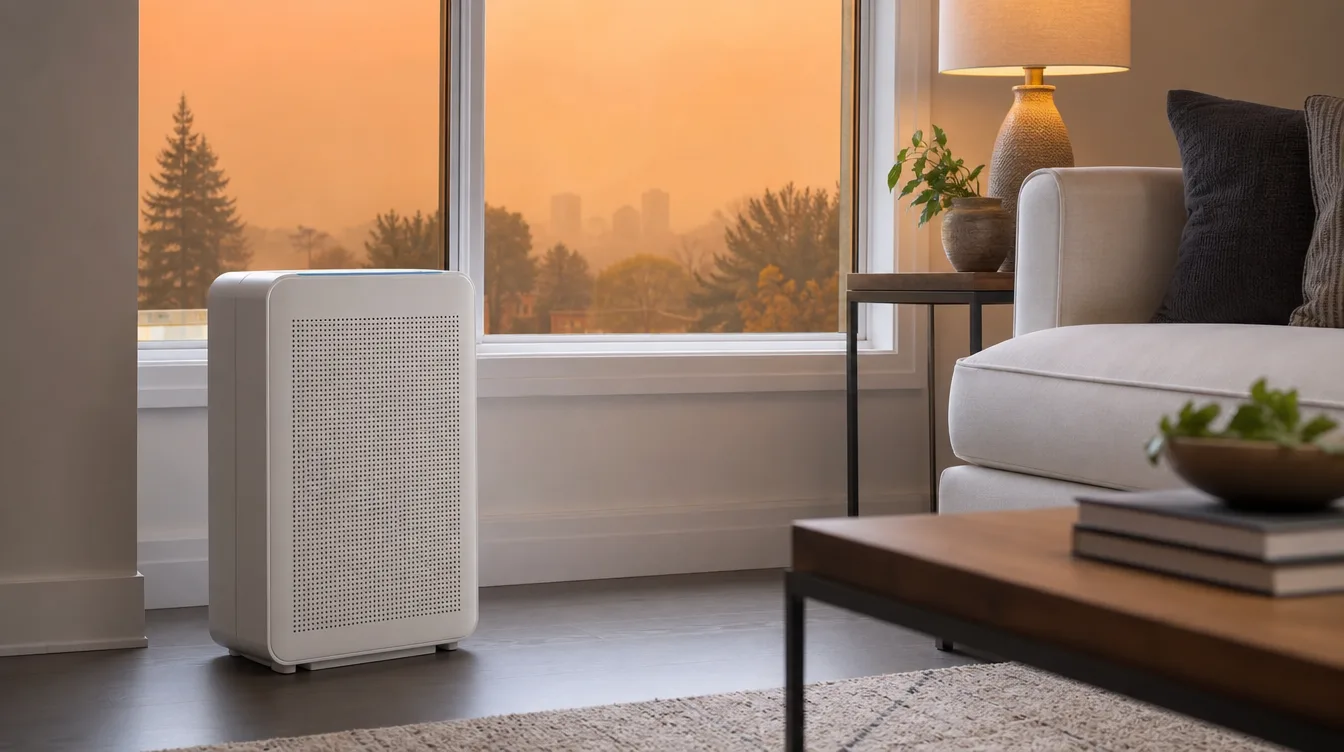
Medify MA-40 Review: The Wildfire-Season Pick, Examined Honestly
373 sq ft (4.8 ACH, AHAM Verifide)
3-stage pre-filter + H13 True HEPA + activated carbon
239 / 231 / 240 CFM (Smoke / Dust / Pollen)
40-53 dB rated; up to 66 dB (HouseFresh)
Quick answer
The Medify MA-40 pairs an H13 True HEPA filter and activated-carbon layer with a high-airflow fan rated at an AHAM Verifide 239 CFM smoke CADR, for honest coverage of about 373 sq ft at 4.8 air changes per hour. It runs three manual speeds with a timer and filter indicator but no sensor, auto mode or app. Rated noise runs from 40.5 dB in sleep mode to 53.3 dB on high.
Methodology & sources
TestedThis review is backed by a validated long-term test record retained by Claire Fontaine.
Verified on August 8, 2026
Pros
- High airflow with a genuine H13-grade HEPA and a real carbon layer for smoke and odor
- AHAM Verifide coverage of about 373 sq ft, a true room-sized smoke machine
- Simple, sensor-free operation with a sleep timer and three speeds
- Sturdy, heavy build aimed at hard wildfire-season duty
Cons
- No whisper-quiet mode; even the sleep speed is audible, and HouseFresh measured up to 66 dBA on high
- The 1,793 sq ft on the box is a slow single-air-change figure, not real cleaning coverage
- No air-quality sensor, auto mode or app
- Marketing leans hard on medical-grade language the room coverage does not uniquely earn
Best for
- Wildfire-season and wood-smoke households that need high airflow and carbon
- Buyers who want a simple, sturdy smoke-and-odor machine with no app
- Rooms up to about 373 sq ft where fast, frequent air changes matter
Spec comparison
| Spec comparison | Medify MA-40 | BLUEAIR Blue Pure 211i Max | BLUEAIR Blue Pure 311i Max |
|---|---|---|---|
| CADR | 245 / 257 / 263 CFM (Smoke / Dust / Pollen, ENERGY STAR MA-40-V4.0) | 435 / 453 / 450 CFM (Smoke / Dust / Pollen, AHAM Verifide) | 283 / 314 / 365 CFM (Smoke / Dust / Pollen, AHAM Verifide) |
| Coverage | 380 sq ft (ENERGY STAR); cleans 896 sq ft in 30 minutes | 674 sq ft (4.8 ACH) | 439 sq ft (4.8 ACH) |
| Noise level | Speed 1: 40.5 dB; Speed 2: 50.3 dB; Speed 3: 53.3 dB; Sleep mode: 40.5 dB | 23-53 dB | 23-50 dB |
| Power | 68 W | 46 W | 32 W |
| Filter type | Pre-filter + True HEPA H13 + active carbon composite | HEPASilent dual filtration; Particle & Carbon main filter + washable fabric pre-filter | HEPASilent dual filtration; Particle & Carbon main filter + washable fabric pre-filter |
| Filter life | 3,000 hours (4-5 months) | 6-9 months (main filter); pre-filter washable | 6-9 months (main filter); pre-filter washable |
| Warranty | Limited lifetime (registered products) | 1 year limited; 3 years with product registration | 1 year limited; 3 years with product registration |
| Dimensions | 22 x 9.9 x 10.9 in (H x W x D) | 22.7 x 14.4 x 14.4 in (H x W x D) | 19 x 12.5 x 12.5 in (H x W x D) |
| Weight | 15.6 lbs | 16.2 lbs | 7.8 lbs |
When wildfire smoke rolls in or a wood stove fills the house, the honest priority is moving a lot of air through a serious filter, fast — and that is exactly what the Medify MA-40 is built to do. It pairs a high-airflow fan with a genuine H13-grade HEPA filter and a real activated-carbon layer, which makes it a sensible pick for smoke season and heavy household odor in a room-sized space. If a purifier that can churn the air in a living room several times an hour during a smoke event is what you are after, the MA-40 belongs on the shortlist.
Who should skip it? Anyone who wants whisper-quiet overnight running, because the MA-40 has no truly silent mode; anyone who expects the 1,793-square-foot figure on the box to be real coverage, because it is not; and buyers who want an air-quality sensor and automatic operation, which the MA-40 does without. It is a simple, sturdy, loud-when-pushed smoke machine, and taken on those terms, a good one.
The wildfire-season case
The MA-40's reputation is built on smoke, and the physics back it up. Two things matter when outdoor wildfire smoke or indoor wood-and-cooking smoke is the problem: how fast the unit can move air through the filter, and whether that filter includes carbon to grab the gas-phase compounds that make smoke smell. The MA-40 delivers on both — a strong fan and a dedicated activated-carbon layer — which is why it recurs on smoke-and-wildfire shortlists. During an active smoke event the goal is frequent air changes, and a machine sized to a real room can turn the air over every ten to fifteen minutes rather than letting smoke linger.
The "medical-grade H13" claim, examined
Medify leans hard on the phrase "medical-grade H13 True HEPA," so it is worth unpacking what is real and what is marketing. The real part: H13 is a genuine step up the HEPA grading scale from the more common H11 or unrated "HEPA-type" media, rated to capture at least 99.95% of the hardest-to-catch particle sizes, and Medify has the filter material lab-checked by Intertek. That is a legitimately good filter.
The marketing part: a filter's grade describes the media on a bench, not how well the whole machine cleans a room. Room performance is governed by clean-air delivery — the fan and the seal — far more than by the filter's headline grade. A superb H13 element behind a modest fan cleans a room no faster than a good True HEPA behind a strong fan. The MA-40 happens to pair its H13 with a capable fan, so it performs well, but the H13 badge itself is not what earns the coverage; the airflow is. Treat "medical-grade" as a filter specification, not a promise of hospital-level results in a living room. For the fuller picture on how filter grades actually differ, see the HEPA vs True HEPA guide.
CADR and the honest room-size math
Medify publishes an AHAM Verifide Clean Air Delivery Rate of 239 CFM for smoke, with 231 CFM for dust and 240 CFM for pollen. AHAM Verifide means the figures were measured by an independent body, which is why they are the numbers to shop by rather than the headline on the box.
Apply the coverage rule this site uses for every purifier: multiply the smoke CADR by 1.5 for the area cleaned at a meaningful 4.8 air changes per hour.
- 239 CFM x 1.5 = about 359 square feet at 4.8 air changes per hour.
Medify's own AHAM figure lands at 373 square feet at that same 4.8-ACH rate, essentially the same answer, and the honest working size for the MA-40. The box, by contrast, advertises 1,793 square feet "in one hour." As Medify's own specification sheet confirms, that headline is a single-air-change number: one slow pass through the filter per hour, a maintenance cadence rather than the fast, repeated cleaning a smoke event demands. The 896-square-foot "in 30 minutes" figure is the same math at two air changes per hour. Shop by the 373-square-foot figure and the MA-40 lands right where it should: a genuine room-sized smoke machine, in the same coverage class as the Winix 5510.
Three real stages of filtration
The MA-40 runs a conventional but well-built three-stage stack. A pre-filter catches hair and large dust and protects the media behind it. The H13 True HEPA filter is the particle workhorse, holding pollen, dust, mold spores, dander and fine smoke particulate. An activated-carbon composite layer handles the gas-phase side of smoke — the smell, and the volatile organic compounds a HEPA filter alone passes straight through. That carbon layer is the reason the MA-40 works as a smoke-and-odor unit rather than a pure particle catcher, though it is a composite layer rather than the deep granular carbon bed of a dedicated odor machine like the Winix 5510, so households with relentless, heavy odor may find it saturates sooner.
Noise: loud when it counts, never silent
Here is the MA-40's real compromise. Medify rates it from a sleep-mode floor of 40.5 decibels up to 53.3 decibels at top speed. Even taken at face value, that 40.5-decibel floor is not a whisper — quieter units idle nearer 24 decibels — so the MA-40 never truly disappears in a silent bedroom. Independent measurement is harsher still: HouseFresh recorded a range of about 46 dBA at the bottom to 66 dBA flat out, with the top speed approaching the loudness of a vacuum cleaner. The practical reading is that the MA-40 is built to be run hard during a smoke event, where the noise is a fair trade for fast cleaning, but it is a poor choice for anyone who needs near-silence to sleep. In a living room during the day the noise is easy to live with; on a nightstand overnight it is not.
Simple operation, no sensor
The MA-40 is deliberately old-school. A front panel offers three fan speeds, a sleep mode, a timer and a filter-change indicator, and that is the whole interface — no air-quality sensor, no auto mode, no Wi-Fi and no app. That means it will not ramp itself up when smoke arrives or drop back down when the air clears; setting the speed is a manual job. For a smoke-season unit that many owners simply run on high when the air is bad and low the rest of the time, the simplicity is defensible, and it removes the sensor-accuracy and app-account headaches that come with smarter machines. But buyers who want a purifier that manages itself should know the MA-40 does not.
Running cost, kept qualitative
The MA-40's economics are straightforward. The pre-filter can be vacuumed to extend its life, while the combined HEPA-and-carbon filter is the recurring consumable, rated for roughly a six-month cycle under normal use and sooner under constant heavy smoke. Because the carbon is doing real work during smoke season, wildfire-region households should expect to replace it toward the shorter end of that window. At 68 watts on high the fan draws more than the ultra-frugal HEPASilent units but nothing unusual for a machine moving this much air, and running it only as hard as the air demands keeps both the filter and the power draw in check. Plan for one to two main filters a year depending on smoke load, and the MA-40 is inexpensive to keep running.
The third-party consensus
Because this site does not run a lab, the honest way to gauge a purifier is to lean on the independent testers who do. HouseFresh's bench supplies the numbers that anchor this review: the 46-to-66 dBA noise range and the confirmation that the MA-40 is a capable, high-airflow smoke unit whose main weaknesses are its noise and its reliance on manual control rather than any shortfall in filtration.
Who should buy it
Wildfire-region and wood-smoke households are the core buyer. The high airflow and dedicated carbon layer are exactly what a smoke event calls for, and the sturdy body is built to be run hard for weeks at a stretch.
Odor-focused buyers who want a simple, sensor-free machine — no app, no account, no fiddling — get a lot of capable air-moving for the outlay.
Room-sized coverage seekers up to about 373 square feet who value throughput over quiet will find the MA-40 delivers real, AHAM Verifide cleaning at that size.
Who should skip it
Light sleepers and bedroom buyers should look elsewhere; the MA-40 has no whisper-quiet mode, and a unit like the Coway Airmega Mighty2 idles far quieter for overnight use.
Large-room and open-plan households that need more than about 373 square feet of real coverage should step up to a genuinely bigger machine such as the LEVOIT Core 600S.
Automation seekers who want a sensor and auto mode will be happier with a smart unit like the Winix 5510, which pairs comparable smoke-and-odor filtration with the app and auto logic the MA-40 lacks.
How it compares
The natural rival is the Winix 5510, and it is an instructive matchup. The two cover a near-identical room size — around 373 to 380 square feet — and both are built around smoke and odor. The Winix pulls ahead on smarts and refinement: it adds a Wi-Fi app, a true auto mode driven by an air-quality sensor, and a deep granular AOC carbon bed, while offering an ionization stage that can be switched off. The MA-40 counters with a simpler, sturdier, sensor-free design and its H13 filter, but it is louder and it will not manage itself. If smoke is a recurring, weeks-long seasonal siege and simplicity and build matter most, the MA-40 makes sense; for the smarter, quieter, self-managing take on the same job, the Winix is the better all-rounder. For the full field of picks, see the best air purifiers guide.
Verdict
The Medify MA-40 is a capable, honest-to-its-purpose smoke machine wrapped in some overheated marketing. Strip away the "medical-grade" language and the 1,793-square-foot box claim, and what remains is genuinely good: a high-airflow fan, a real H13 HEPA filter and an activated-carbon layer that together make quick work of wildfire smoke and heavy household odor across a room-sized space. Its AHAM Verifide coverage of about 373 square feet is ordinary rather than exceptional — right in Winix 5510 territory — and its noise is its real cost, with no whisper-quiet mode and independent measurement reaching 66 dBA on high. Buy it for what it is: a simple, sturdy, loud-when-pushed smoke specialist for a room, run hard when the air is bad. On those honest terms, when smoke season arrives, the MA-40 earns its place.
Editorial summary
Medify MA-40 review: H13 True HEPA plus carbon with a 239 CFM smoke CADR and honest 373 sq ft coverage, built loud and simple for wildfire season.
Where to buy
Check the merchant for the current price and availability. We may earn a commission.