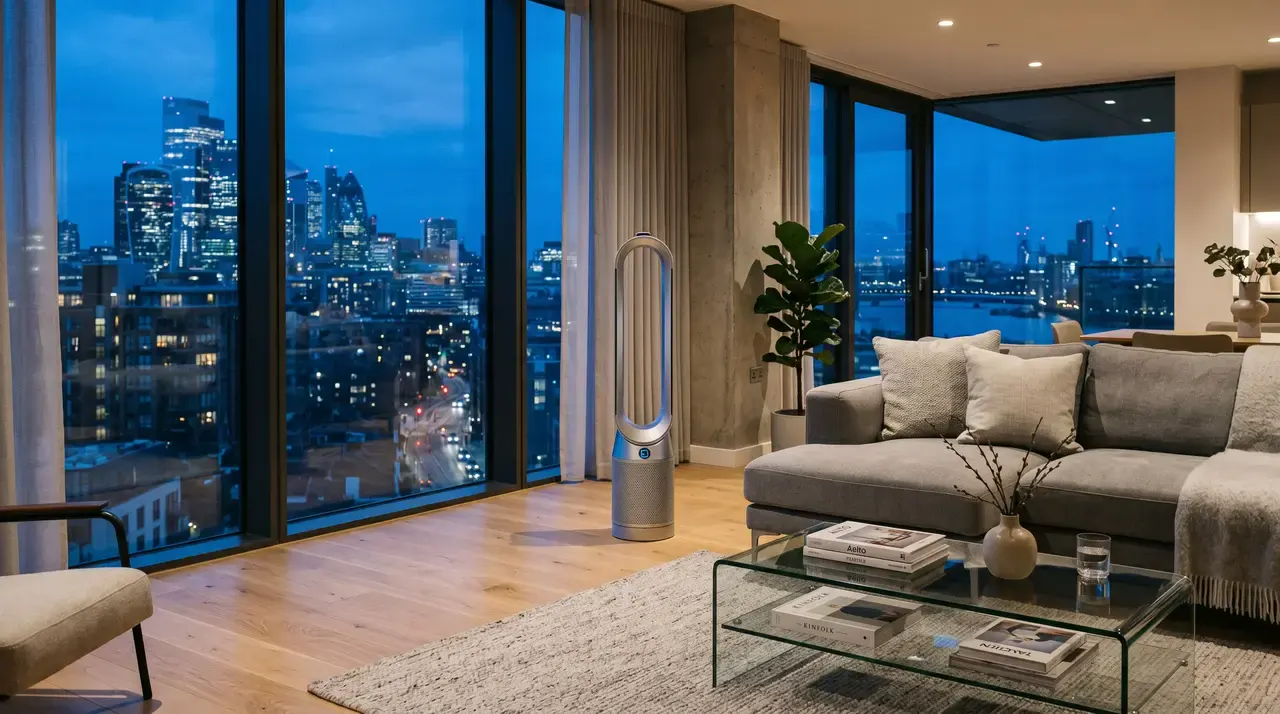
Dyson Purifier Cool Review (2026): Fully Sealed HEPA H13 in a Bladeless Fan
800+ sq ft
HEPA H13 + Carbon
38-61 dB
10.2 lbs
Quick answer
The Dyson Purifier Cool (TP07) combines a bladeless Air Multiplier fan with a fully sealed HEPA H13 and activated-carbon filtration system rated to capture 99.97% of particles down to 0.3 microns. An LCD screen reports PM2.5, PM10, VOC and NO2 levels in real time, and the tower oscillates through 350 degrees. Dyson does not publish an AHAM CADR rating for this model.
Methodology & sources
TestedThis review is backed by a validated long-term test record retained by Claire Fontaine.
Verified on August 8, 2026
Pros
- Powerful Air Multiplier™ airflow
- Fully sealed HEPA H13 filtration
- Real-time air quality LCD display
- 350° oscillation coverage
Cons
- Premium price point
- No disclosed CADR rating
- Louder than competitors at max speed
Best for
- Large rooms and open spaces
- Design-conscious buyers
- Those wanting fan + purifier combo
Spec comparison
| Spec comparison | Dyson Purifier Cool | BLUEAIR Blue Pure 211i Max | BLUEAIR Blue Pure 311i Max |
|---|---|---|---|
| CADR | Not disclosed | 435 / 453 / 450 CFM (Smoke / Dust / Pollen, AHAM Verifide) | 283 / 314 / 365 CFM (Smoke / Dust / Pollen, AHAM Verifide) |
| Noise level | Up to 46 dB (purifier mode, speed 4); up to 61.4 dB (fan mode, max flow) | 23-53 dB | 23-50 dB |
| Power | 6-40 W input; standby under 0.5 W | 46 W | 32 W |
| Filter type | 360-degree glass HEPA H13 + activated carbon filter (fully sealed to HEPA H13) | HEPASilent dual filtration; Particle & Carbon main filter + washable fabric pre-filter | HEPASilent dual filtration; Particle & Carbon main filter + washable fabric pre-filter |
| Filter life | 12 months or when notified (6 months at 24h/day use) | 6-9 months (main filter); pre-filter washable | 6-9 months (main filter); pre-filter washable |
| Warranty | 2-year | 1 year limited; 3 years with product registration | 1 year limited; 3 years with product registration |
| Dimensions | 41 x 8 x 4.72 in (H x W x D) | 22.7 x 14.4 x 14.4 in (H x W x D) | 19 x 12.5 x 12.5 in (H x W x D) |
| Weight | 11 lbs | 16.2 lbs | 7.8 lbs |
| Coverage | — | 674 sq ft (4.8 ACH) | 439 sq ft (4.8 ACH) |
When you think of modern, high-end home appliances, Dyson is inevitably one of the first brands that comes to mind. Known for their striking, futuristic aesthetics and premium engineering, Dyson has completely reimagined what an air purifier can look like. The Dyson Purifier Cool (often referred to by its model designation, the TP07) is the brand's flagship standard purifying fan, blending their signature bladeless fan technology with serious air filtration capabilities.
The air purifier market has exploded over the last few years. Driven by rising concerns over seasonal wildfire smoke, increasing urban pollution, and a general heightened awareness of indoor air quality, consumers are no longer treating air purifiers as niche medical devices. They are becoming standard home appliances.
However, this surge in popularity has highlighted a significant consumer pain point: most air purifiers are incredibly ugly. They are often large, plastic monoliths that dominate a room visually and audibly. Consumers are increasingly searching for hybrid devices—machines that can clean the air, cool the room, and look good doing it. The Dyson Purifier Cool sits exactly at this intersection, making it one of the most highly searched and debated air purifiers on the market.
Design and build quality
Unboxing the Dyson Purifier Cool is an experience that mirrors buying a high-end smartphone. The packaging is entirely recyclable, cleverly engineered using folded cardboard rather than environmentally harmful styrofoam. Right out of the box, the machine makes a striking visual statement.
Despite its height, the unit has a relatively small footprint. The cylindrical base is roughly 8.7 inches in diameter, making it incredibly easy to tuck into a corner or place alongside a media console without eating up valuable floor space. Furthermore, the machine weighs in at just 10.2 lbs. This lightweight design is a massive advantage over traditional, bulky air purifiers. Moving the Dyson from the living room to the bedroom is effortless, requiring only one hand to grip the loop amplifier and carry it down the hall.
The build quality truly shines when you examine the filtration system. The base of the unit features a perforated shroud that clicks off to reveal the filters. Dyson uses a 360-degree glass HEPA H13 filter combined with an inner layer of activated carbon. Installing the filters is foolproof; they simply snap into the semi-circular shrouds, which then click magnetically and mechanically into the base of the machine.
Crucially, Dyson advertises this machine as featuring "fully sealed HEPA H13 filtration." This is a vital technical distinction. Many budget air purifiers use HEPA filters, but their plastic housings have microscopic gaps. When the fan pulls air through the machine, some of the dirty air bypasses the filter entirely and is blown right back into the room. The Dyson Purifier Cool is engineered with rubber gaskets and precision-molded seals so that the entire machine, not just the filter media, meets the HEPA H13 standard. What goes inside stays inside, capturing 99.97% of particles as small as 0.3 microns.
On the front of the base sits a small, circular LCD screen. This is one of the most brilliant design choices Dyson has made. It provides real-time data on your indoor air quality, displaying colorful, easy-to-read graphs that track PM2.5, PM10, VOCs (Volatile Organic Compounds), and NO2 (Nitrogen Dioxide). It also shows the current room temperature, humidity, and filter life.
Rounding out the design is the remote control. It is a small, elegantly curved piece of metal and plastic that rests magnetically on the top curve of the loop amplifier. It’s a small touch, but it perfectly encapsulates Dyson's attention to user experience—you never have to wonder where you left the remote because it has a dedicated, satisfying magnetic home right on the machine itself.
Performance
Let's start with the airflow, which is powered by Dyson's proprietary Air Multiplier™ technology. Unlike traditional fans that chop the air with fast-moving blades—creating a buffeting, uneven breeze—the Dyson pulls air into the base, pushes it up into the loop amplifier, and forces it through a narrow slit that runs around the inner edge of the loop. This creates a low-pressure area that entrains surrounding air, multiplying the initial airflow.
Dyson publishes its POLAR chamber-test protocol for this machine: in the company's own controlled test room, the purifier detects PM2.5 and VOC spikes on its onboard sensor and ramps fan speed automatically. Dyson also reports formaldehyde and NO2 destruction figures from that same controlled-chamber methodology. These are manufacturer-reported figures from Dyson's own protocol, not independent measurements — but they describe the same auto-response behavior the LCD displays in daily use.
The activated carbon filter also performed admirably against odors. After cooking heavily spiced meals, turning the Dyson on helped neutralize lingering food smells within an hour. It is worth noting, however, that carbon filters in all air purifiers saturate over time, so if you frequently burn food or smoke indoors, you will need to replace the filters more often than the standard 12-month recommendation.
Fortunately, Dyson includes a dedicated Night mode for quiet sleep. When activated, Night mode dims the LCD screen completely so it won't disturb your sleep in a dark bedroom, and it caps the fan speed at level 4. This ensures the machine continues to monitor and purify the air, but it will never ramp up to a disruptive volume, even if air quality drops.
Another brilliant feature for winter months is the "Backward airflow mode" (often called diffused mode). If you want the air purification benefits but don't want a cold breeze blowing on you, a simple button press diverts the air out the back of the loop amplifier. It still purifies the room efficiently, but without the wind-chill effect.
Pros and cons in detail
The Pros
Powerful Air Multiplier™ airflow: The smoothness of the breeze generated by this machine cannot be overstated. It eliminates the choppy, buffeting air of traditional bladed fans. The velocity at higher speeds is genuinely impressive, capable of pushing a cooling breeze across a 30-foot room with ease, making it a highly effective summer cooling companion.
Fully sealed HEPA H13 filtration: This is where the Dyson goes from being a fancy fan to a serious health device. The fact that the entire machine meets the HEPA H13 standard means you can trust that the air coming out is genuinely clean. For allergy sufferers, knowing that 99.97% of pollen, pet dander, and dust mites are trapped securely inside the sealed chassis provides immense peace of mind.
Real-time air quality LCD display: The onboard screen is a game-changer for user feedback. Instead of just relying on a vague color-changing light like many budget purifiers, the Dyson tells you exactly what is polluting your air. Watching the PM2.5 graph spike when you open a window near a busy street, and then watching it steadily fall as the machine does its work, makes the invisible process of air purification highly tangible.
350° oscillation coverage: Most oscillating fans sweep back and forth in a 90-degree arc. The ability of the Dyson to rotate a full 350 degrees means it can be placed in the dead center of a room and actively project clean air into every single corner. It is a fantastic feature for large, open-plan living and dining areas.
Night mode for quiet sleep: The thoughtful implementation of Night mode makes this unit an excellent bedroom companion. By capping the fan speed and turning off the bright LCD screen, Dyson ensures that light sleepers won't be jolted awake by a sudden rush of air or a glowing screen if the machine detects a spike in dust during the night.
The Cons
No disclosed CADR rating: For data-driven consumers, the lack of an AHAM-certified Clean Air Delivery Rate is frustrating. While Dyson's proprietary POLAR test has merit for whole-room circulation, the refusal to participate in the industry-standard CADR test makes it difficult to do a true apples-to-apples comparison with other brands regarding raw purification speed.
Louder than competitors at max speed: At 61 dB on speed 10, the Dyson Purifier Cool is loud. The physics of forcing high volumes of air through a millimeter-thin slit inevitably creates a loud rushing sound. While lower speeds are whisper-quiet, the machine can be highly intrusive when it needs to clear heavy pollution quickly.
How it compares
To truly understand the value of the Dyson Purifier Cool, it helps to see how it stacks up against the heavyweights of the air purifier market.
Compared to the Coway Airmega 400: The Coway Airmega 400 is a powerhouse. It is designed for massive spaces and boasts a phenomenal, independently verified CADR rating. If you pit the Coway against the Dyson in a race to clear a smoke-filled room, the Coway will win. It is also significantly quieter at its maximum speed. However, the Coway is a large, boxy unit that looks like a piece of medical equipment, and it offers zero cooling fan capabilities. If you want pure, silent air-scrubbing power, get the Coway. If you want a stylish cooling fan that also purifies, the Dyson wins.
Who should buy it
The Dyson Purifier Cool is tailor-made for a specific type of consumer. It is best for:
- Large rooms and open spaces: Thanks to its 800+ sq ft coverage and 350-degree oscillation, it excels at circulating clean air throughout expansive living rooms, great rooms, and open-concept kitchen/dining areas where stagnant air is a problem.
- Design-conscious buyers: If you have spent time and money curating the interior design of your home, you likely do not want a bulky plastic box ruining the aesthetic. The Dyson is a genuine conversation piece that looks like high-end modern furniture.
- Those wanting a fan + purifier combo: If you currently drag a pedestal fan out of the closet every summer and run a separate air purifier year-round, the Dyson allows you to consolidate. It is a fantastic two-in-one device that saves floor space and outlet usage.
Who should skip it
Despite its brilliance, this machine is not for everyone. You should skip it if you are:
Verdict
Yes, the premium price point is steep, and the lack of a standardized CADR rating will forever annoy air quality purists. Furthermore, the noise level at maximum speed is a trade-off for that sleek, bladeless design.
However, if you have the budget for it, the Dyson Purifier Cool justifies its cost by solving multiple problems at once. It eliminates the need for a separate summer fan, it scrubs the air of allergens and pollutants with clinical efficiency, and it does it all while elevating the aesthetic of your living space. For design-conscious buyers with large rooms who want the ultimate all-in-one hybrid appliance, the Dyson Purifier Cool remains the benchmark to beat.
Editorial summary
Dyson Purifier Cool review: a bladeless Air Multiplier fan with fully sealed HEPA H13 filtration, 350-degree oscillation and a live air quality display.
Where to buy
Check the merchant for the current price and availability. We may earn a commission.